
The First Jewish Printers
Abraham Garton (c. 1450-1510) was born in Spain and moved with his family to Calabria, Italy sometime before the Spanish Expulsion of 1492 (which took place on Tisha b’Av). Little is known of his life. Inspired by Johannes Gutenberg, who produced the first printed book in Europe in 1439, Garton established his own printing press to produce Jewish books. His first publication was the Torah commentary of the great Rashi, produced in 1475. In order to avoid using the holy script of the Torah itself, and to be able to fit more letters on a page, Garton decided to use a special cursive Hebrew font previously developed by Sephardic rabbis. This went on to become the standard font for printing the commentary of Rashi on the Torah and Talmud, as well as the commentaries of other sages, and is referred to as “Rashi script” – even though Rashi himself never used it!

Rashi script, originally developed by Sephardic rabbis in Spain (top) compared to regular Hebrew script (bottom).
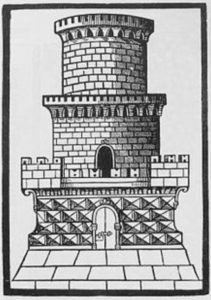
Emblem of the Soncino family and printing press
Several years later, Yehoshua Shlomo (the son of Ashkenazi Jewish immigrants to Italy) established a Hebrew printing press in the town of Soncino, and later in Naples. He undertook the publication of the entire Talmud, starting with the first tractate, Berakhot, in 1483. The work was taken over by his nephew, Gershom Girolamo Soncino (c. 1460-1533). A scholar in his own right, Gershom was fluent in Greek, Latin, and Hebrew. In addition to the Talmud, he published books of Torah and the Megillot, as well as various rabbinic texts. He traveled all over Europe to find manuscripts that he could publish. He also produced non-Jewish books, and became famous among Italians for the high quality of his work. All in all, he produced some 200 works, and was the first to use illustrations in a Hebrew book. Soncino later established printing presses in other cities, the last in Constantinople, where he lived out the remainder of his life. He became wealthy, and used his funds to assist Sephardic Jews following the 1492 Expulsion from Spain, and the Portuguese Expulsion in 1497. The Soncino family printed Jewish books until 1557, playing a key role in the wide-spread dissemination of Jewish wisdom, and opening up the study of Jewish texts to the masses. Soncino Press was reestablished in London in the late 19th century, and continues to publish Jewish books today.
How to Observe Judaism in Outer Space
Words of the Week
Life isn’t about finding yourself. Life is about creating yourself.
– George Bernard Shaw
 Manoel Dias Soeiro (1604-1657) was born in Madeira, an island off of Portugal, where his parents fled from the Portuguese Inquisition. They soon moved to the Netherlands, where Soeiro grew up and became a respected rabbi and author, known by his Hebrew name Menashe ben Israel. In Holland, he established the first Hebrew printing press at the young age of 22, and his writings (in five languages!) would gain great fame, not only in the Jewish community, but among the greatest scholars and philosophers of the age, including Vieira, de Groot, and Huet. A portrait of Soeiro was even painted by Rembrandt! A great kabbalist, Soeiro wrote and published one of the earliest Jewish treatises on reincarnation, called Nishmat Hayim. Among his students was the infamous Baruch (Benedict) Spinoza. In 1638, Soeiro moved to Brazil. At the time, there was a popular notion that the natives were actually the Lost Tribes of Israel. This inspired Soeiro to take up the role of helping Jewish causes around the world. His first stop was England, where virtually no Jews lived since they were expelled in 1290. Soeiro worked hard to open the doors to their return, and in December 1655, the re-admittance of Jews to England was granted. Sadly, Menashe could not continue his work. Upon return to the Netherlands, his son passed away. Unable to contain the grief, Soeiro passed away himself in the midst of the funeral.