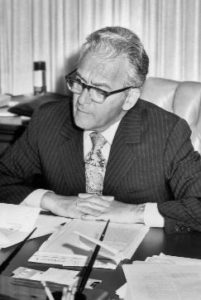
 Sol Price (1916-2009) was born in New York City to Jewish-Russian immigrants from Belarus. He grew up in San Diego, where he earned a philosophy degree at San Diego State University before getting a law degree from the University of Southern California. Price was admitted to the bar in 1938. After over a dozen years as a business lawyer, Price had an idea to open a new kind of department store, offering wholesale prices on quality goods sold in bulk. Price opened his first store, called FedMart, in an old airport hangar in 1954. He charged a small membership fee ($2 per family) and kept prices even lower by avoiding advertising, major credit cards, and expensive real estate, and maintaining a small inventory. The model was a great success, and Price expanded rapidly. He pioneered many innovations in retail, including being the first to sell gasoline at wholesale prices, and being the first to have an in-store pharmacy and opticianry. By 1974, FedMart had 45 stores and over $300 million in sales. The following year, FedMart was bought out by a German retailer, and Price was soon kicked out of the company. He then started a new chain, Price Club, in an old factory once owned by Howard Hughes. Price Club expanded quickly, too, and went public in 1980. A few years later, one of Price Club’s employees teamed up with a wealthy lawyer (whose own Jewish family was successful in retail) to start a competing wholesaler, called Costco. In 1993. Price Club merged with Costco to form PriceCostco, together having 206 locations and $16 billion in sales. By 1997, Costco became the official company name, and today, Costco has over 700 locations around the world, with 85 million members, and 174,000 employees. It is the second largest retailer, and the 18th richest company in the world, with $120 billion in revenue. Costco is second only to Wal-Mart. Ironically, Sam Walton wrote in his book that he “borrowed” most of his ideas from Sol Price, and called his store “Wal-Mart” because he liked Sol Price’s FedMart! Not surprisingly, Price is often called the “father of the wholesale retail industry”. He was also a generous philanthropist, having donated tens of millions to various causes, especially in his hometown of San Diego.
Passover Starts Monday Evening!
Words of the Week
On his birthday, a person should meditate, recall and contemplate his past, and correct and repent that which requires correction and repentance.
– Rabbi Menachem Mendel Schneerson, the Lubavitcher Rebbe