Tag Archives: New York

Jews of the Week: Straus and Bloomingdale

Macy’s and Bloomingdale’s 
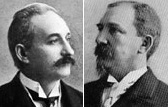
Lyman and Joseph Bloomingdale

Lyman and Joseph Bloomingdale

Lyman Bloomingdale (1841-1905) and Joseph Bloomingdale (1842-1904) were the sons of German-Jewish immigrants who settled in New York. Their father Benjamin started a small clothing shop, and it was here that Lyman and Joseph sold their first hoop skirts for ladies. In 1872, the brothers opened their own store. Business boomed, and in 1886, the company expanded and opened its current world-famous Bloomingdale’s location. Over the next century, Bloomingdale’s went on to open dozens of stores across America, and become one of the most recognizable department store brands in the world. In 1930, Bloomingdale’s joined together with another department store giant – Macy’s. Macy’s began in 1858 as a small dry goods store. Thirty years later, a pair of Jewish brothers (who originally only supplied Macy’s with tableware) became partners in the business, and the shop’s fortunes boomed.
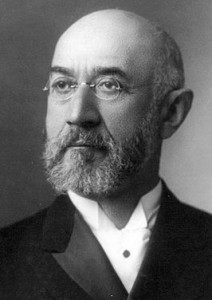
Isidor Straus

The brothers were Isidor Straus (1845-1912) and Nathan Straus (1848-1931), who were also German-Jewish immigrants like the Bloomingdales. Eventually, the two became the sole owners of Macy’s, and turned the company into an internationally-recognized brand, which now has 850 locations. The elder Isidor served as a US Congressmen and was a noted philanthropist and social activist. Tragically, he and his wife were aboard the Titanic when it sank in 1912. Despite his wealth and status, which immediately guaranteed him a seat on a lifeboat, Isidor refused so that all women and children could be saved first. He and his wife did not survive. His brother Nathan was also supposed to cruise the Titanic, but instead decided to take a trip to Israel. This decision saved his life, and Nathan saw this is a divine message.
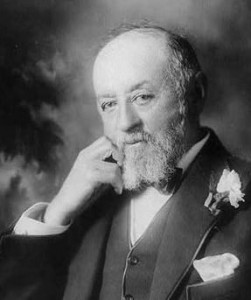
Nathan Straus

Nathan Straus dedicated the rest of his life to support the Jewish state, going on to donate two thirds of his wealth for the cause. His money opened up countless schools, health clinics and public kitchens in Israel. The modern city of Netanya is named after him. Meanwhile, Nathan also did a great deal at home. He opened a pasteurized milk institute that gave out free milk to children, and is credited with significantly reducing the incidence of milk-borne diseases. During the recession of 1893, he gave away coal and meat for free, opened lodgings for 64,000 people, and provided 50,000 meals for a penny each. In the recession of 1914-15 he provided over one million such penny meals, and during World War I, sold his private yacht in order to feed orphans. His personal motto was: “The world is my country, to do good is my religion.”

Words of the Week

God transforms spirituality into physicality; the Jew makes physical things spiritual.
– Rabbi Israel Baal Shem Tov

Jew of the Week: Ruth Gruber

Journalist, Photographer, War Hero

Ruth Gruber

Ruth Gruber

Ruth Gruber (b. 1911) was born in Brooklyn to Russian-Jewish immigrants. By 15 she was already studying at New York University, and at 20 received a doctorate from the University of Cologne, which many believe made her the youngest person in the world to hold a Ph.D. While studying in Germany, she experienced Nazism first hand, and brought back some of the earliest accounts of these horrors to the US. Having always dreamed of being a writer, Gruber finally began her writing career in 1932. A few years later, she was among the first foreign correspondents in the Soviet Union. During World War II, Gruber served as the Special Assistant to the Secretary of the Interior. The seminal moment of her life came in 1944, when she was sent on a special mission to save 1000 Jewish refugees and American soldiers trapped in Italy. Their convoy of 29 ships sailed through treacherous waters and managed to arrive safely in the US. To protect her in case she was captured, she was awarded the rank of “General” (and therefore could not be killed by enemy soldiers according to the Geneva Conventions). This was America’s one and only mission to save Jews during the entire war. Gruber later helped these Jews gain the necessary documentation to stay in the US and not be deported. After the war, Gruber returned to journalism and was stationed in Israel for a time. She witnessed, photographed, and covered the famous voyage of the Exodus that carried 4500 Jewish refugees. She later assisted in the plight of Ethiopian Jewry. Gruber went on to write 19 books and many popular articles. She has won numerous awards for her work, and in 2010 a documentary about her life was released. Gruber will soon celebrate her 103rd birthday. She has been described as a “scholar, writer, journalist and humanitarian, a world class photojournalist.”

UPDATE: Sadly, Ruth Gruber passed away in November of 2016.

Words of the Week

Figure out what you’re willing to die for. Then live for it.
– Rabbi Noach Weinberg

Jew of the Week: Ray Kurzweil

“Revolutionary Who Made America”

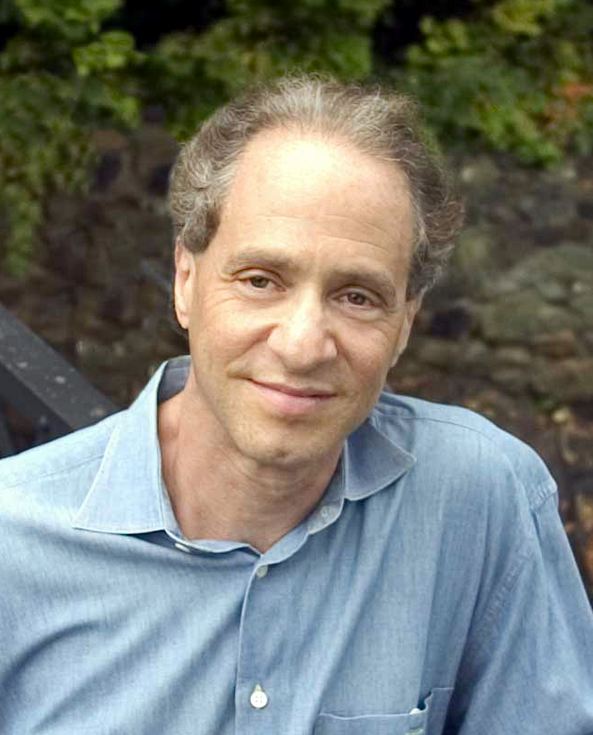
Ray Kurzweil

Ray Kurzweil

Raymond Kurzweil (b. 1948) was born in New York to Austrian-Jewish parents who escaped Europe before the start of World War II. He was fascinated by science-fiction from a young age and by age 5, decided that he wanted to be an inventor. He was already designing and building computers by 12, and developed a theory for the neocortex of the brain by 14. The following year he wrote his first computer program, and a couple years later won the International Science Fair for creating a computer that could compose music. While studying at MIT, he created a program that matches high school students with colleges, and sold it for the equivalent of about $700,000 in today’s value. In 1974, Kurzweil created a scanner that could read most fonts, then used the technology to create a reading machine for the blind. At the behest of Stevie Wonder, Kurzweil then turned to improving music technology, inventing a new generation of synthesizers whose quality was indistinguishable from that of live instruments. Kurzweil went on to develop one of the first speech recognition systems, followed by devices that assist people with learning disabilities, blindness, ADD, and dyslexia. He published his first book in 1990, followed by six more to date, mostly about the future of technology, as well as nutrition and health. Five of the books have been bestsellers. Many of his predictions about the future have already come true. Kurzweil has won a great number of awards, and has been inducted into the National Inventors Hall of Fame, while being described as one of the “revolutionaries who made America”. He now works full-time for Google, developing machine learning and language processing. When he dies, Kurzweil intends to have his body cryogenically frozen and stored until a future time when technology might resurrect him.

Words of the Week

If you drop gold and books, pick up first the books, and then the gold.
– Sefer Hasidim