The First Native American Jew on a Supreme Court
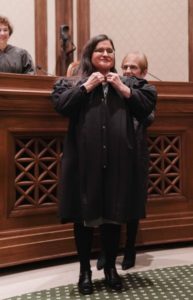
Raquel Montoya-Lewis at her swearing-in ceremony
Raquel Montoya-Lewis (b. 1968) was born in Spain to a Jewish mother from Australia and a Native American father from New Mexico. Because her father worked for the US Air Force, the family travelled a lot when she was young. Yet, they always returned to the Pueblo of Isleta reservation which was their home. Her mother made sure to instill Jewish values and traditions, too. Montoya-Lewis went on to study at the University of New Mexico, and then at the University of Washington School of Law. To gain a deeper understanding of how laws affect societies, she also got a Master’s degree in social work. Although she sought to become a law professor, Montoya-Lewis was invited to preside over a number of trials in Native American communities. Eventually, she became the chief judge of the Lummi nation, Upper Skagit Indian Tribe, and the Nooksack Indian tribe, among others. Meanwhile, she taught law at Western Washington University. In 2015 Montoya-Lewis was appointed to the Superior Court of Whatcom County. After being recognized for her exceptional work, she was recommended for Washington State’s Supreme Court. Last month, Montoya-Lewis was officially sworn in. That makes her the first ever Native American tribal member (and first Native American Jew, of course) to hold such a position, and only the second Native in American history to be a state supreme court judge. At her swearing-in ceremony, she invited both a rabbi and a Native American leader to speak. Montoya-Lewis herself said: “I was raised to remember that I come from those who survived. My ancestors on both sides of my family survived genocide, survived institutional boarding schools, survived attempts to eradicate their cultures, and yet as my father reminded me often, ‘we survived’… I am here because of their resilience, their courage, their intelligence, and their deep commitment to what is just.”
Words of the Week
The fact that religions through the ages have spoken in images, parables, and paradoxes means simply that there are no other ways of grasping the reality to which they refer… But that does not mean that it is not a genuine reality. And splitting this reality into an objective and a subjective side won’t get us very far.
– Niels Bohr, Nobel Prize-winning physicist

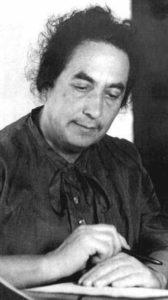
 Simone Annie Liline Jacob (1927-2017) was born and raised in Nice, France. Just after finishing high school, her entire family was rounded up and sent to Auschwitz. Jacob’s mother, father, and brother perished in the Holocaust; two sisters survived. After being liberated from the camps, Jacob settled in Paris and studied law and politics. There, she met her soon-to-be husband Antoine Veil, with whom she would be married for 66 years. In 1956, she became a magistrate, and worked for the French Ministry of Justice, heading its penitentiary system. She was hailed for her role in dramatically improving prison conditions, and was known to regularly visit prisons on her days off. By 1964, Veil had become France’s Director of Civil Affairs. She worked tirelessly for women’s rights, and succeeded in finally getting French women full equality in legal matters. In 1970, Veil took over as secretary general of the Supreme Magistracy, then became Minister of Health in 1974, making her the first female minister in French history. Among her most famous laws was opening access to contraceptives, legalizing abortion (still known as “Veil’s Law”, which she intended only as a “last resort, for desperate situations”), and banning smoking in public areas. She also introduced maternity benefits, improved hospital conditions, enhanced the medical school curriculum, and worked to stop the illegal harvesting of organs from the deceased. Meanwhile, Veil worked for the European Economic Community, believing that a unified Europe was the only way to prevent another devastating war. When the EEC was reformed as the European Union, she was elected to its parliament, and shortly after, as its first president. She would serve on the European Parliament until 1993, in its Environment, Health, and Political Affairs Committees. Veil then returned to the French government, serving as Minister of State and Minister of Health until 1995. She continued her work in France and Europe until her last days, and faced a great deal of anti-Semitism throughout, including death threats and swastikas painted on her car and home. Not surprisingly, in recent years her greatest passion was Holocaust education, and she was president of the Foundation for the Memory of the Shoah. Among her many awards are the prestigious Charlemagne Prize, the Truman Award for Peace, the Legion of Honour, and the Order of the British Empire. In 2008, Veil became one of the forty “immortal” members of the illustrious French Academy. She also held 18 honourary degrees, including one from Yale and another from Yeshiva University. Sadly, Simone Veil passed away earlier this year, just shy of her 90th birthday. She was laid to rest with full military honours in the Pantheon, Paris’ famous mausoleum, alongside just 71 of France’s most cherished figures, including Voltaire and Rousseau. She remains among the most revered women in French history.