
Israel’s Indiana Jones
 Eilat Mazar (1956-2021) was born in Israel to a family of archaeologists, and grew up playing and learning on excavation sites. Her grandfather, Benjamin Mazar, was the State of Israel’s first official archaeologist, and was the president of the Hebrew University. Eilat studied archaeology at the same university, and began her field work in 1981. She made a big splash right away by discovering the Royal Quarter of the ancient City of David in Jerusalem, including what is thought to be the royal palace of King David himself. She went on to uncover some of the biggest finds of the last century, including parts of the walls built by King Solomon, the seal of King Hezekiah, and the seal of the Prophet Isaiah. Mazar was driven by her belief that the Tanakh records actual historical events (whereas many of her secular colleagues often viewed the Tanakh as mythology). She would say that “I work with the Bible in one hand and the tools of excavation in the other.” Over the decades, her work played a major role in helping to prove the authenticity of the Bible. Mazar discovered countless treasures from the First and Second Temples in Jerusalem, and was a vocal activist trying to stop Palestinian and Jordanian authorities from destroying Jewish artifacts on the Temple Mount. (The worst case of this was in November 2000, when some 6000 tons of precious earth from the Temple Mount was illegally excavated by the Waqf and dumped in a landfill.) In 2013, Mazar discovered a large cache of treasure from the 7th century that contained a gold coin depicting a menorah, shofar, and Torah. She taught at the Hebrew University and published three books on archaeology, along with dozens of journal articles. She also paved the way for more female archaeologists to enter the field. Despite suffering from an illness, Mazar continued working and digging. Sadly, she passed away earlier this week. Israel Prize winner David Be’eri said that she “will forever be remembered as a pioneer standing shoulder to shoulder with the greatest scholars of Jerusalem throughout the ages.”
Archaeological Proof for the Torah and Exodus
Words of the Week
I fully understand that any minority would prefer to be a majority, it is quite understandable that the Arabs of Palestine would also prefer Palestine to be the Arab State No. 4, No. 5, No. 6 – that I quite understand; but when the Arab claim is confronted with our Jewish demand to be saved, it is like the claims of appetite versus the claims of starvation.
– Ze’ev Jabotinsky

Some of Eilat Mazar’s biggest finds (clockwise from top left): gold medallion with menorah, shofar, and Torah scroll from the 7th century CE; seal of King Hezekiah, 7th century BCE; King Solomon’s walls, 10th century BCE; seal of the Prophet Isaiah, 7th century BCE.
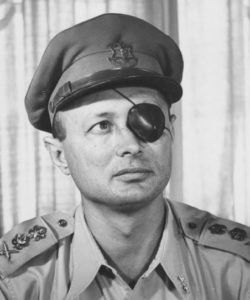 Moshe Dayan (1915-1981) was born on the first kibbutz,
  Renata Sobel (b. 1930) was born in Chelm, Poland. Orphaned at a young age, she was raised by her grandparents. When the Nazis occupied Poland, the family managed to escape and spent the war years in the harsh conditions of Siberia. Young Renata was unable to receive a formal education. After the war, she was engaged to Eliezer Reisfeld—on the condition that he allow her to pursue an education. As a child, Renata was inspired by a biography of Marie Curie and wished to become a scientist, too. The young family made aliyah to Israel in 1950 and settled in Jerusalem. There, Renata Reisfeld took up studies at the Hebrew University. Despite having no knowledge of Hebrew or English, she was the first to complete the entrance exam into the prestigious chemistry program that had only 23 spots. Reisfeld earned her Ph.D, then went to Oregon State University for post-doctoral work. One of Reisfeld’s main areas of research has been photovoltaic cells, and she played a big role in helping to bring down the cost of solar panels to make renewable solar energy possible on a large scale. She is also an expert on nanotechnology and solid state lasers. By 1975, Reisfeld had become the head of the chemistry department at Hebrew University. The following year, she was invited to speak at a conference in Paris. Her flight from Tel-Aviv made a stop in Athens, where Palestinian and German hijackers took control of the plane and diverted it to Entebbe, Uganda. Because she was one of the few hostages that spoke English, she represented the group of 102 passengers, and spoke with Idi Amin. The dictator took a liking to her, and when she asked him to take the hostages out on a tour of Uganda, Amin agreed! Eventually, the hostages were rescued in a daring raid by Israeli commandoes (which took the life of