Israel’s Favourite News Anchor – and Rebbetzin
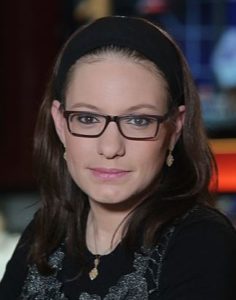 Sivan Rahav (b. 1981) was born in Herzliya to a secular family. She knew she wanted to be a journalist from childhood, and would already interview her friends in second grade. By 8, she earned herself a “children’s press” card, and by 14 was interviewing the likes of Yitzhak Rabin and Shimon Peres. Meanwhile, Rahav used her journalistic skills to dig into her roots, and soon returned to Orthodox observance. After finishing high school early, she completed her degree in political science from Tel-Aviv University in just two years, then served in the IDF as a military reporter. During this time, she met her future husband, a fellow Orthodox IDF reporter, Yedidya Meir. The two still work on their biggest stories together – Yedidya hosting a show on Radio Kol Chai and writing for the B’Sheva newspaper, and Sivan hosting a show on Galei Tzahal (Army Radio), writing for Yediot Ahronot (Israel’s largest newspaper), and hosting Channel 2’s prime-time television news hour. During her last maternity leave (after giving birth to her fifth child), she realized she was tired of the negativity and politics of news, and decided to devote more time to spreading positive, spiritual Jewish wisdom. She started giving weekly Torah classes in Jerusalem and Tel-Aviv, which now draw over 1000 people in packed venues. A master of social media, her Torah thoughts regularly reach over a million listeners through Facebook, Instagram, WhatsApp, Twitter, and YouTube. Rahav-Meir also published a bestselling book on the weekly parasha, translated into English last year. In addition to recently being voted Israel’s favourite female news personality, she has become one of Israel’s most successful kiruv speakers, and a tremendous role model for all baalei teshuva. Rahav-Meir is making waves in the world of Israeli journalism, too, and helping to stem the long-standing anti-religious bias of the secular Israeli media. “For secular reporters,” she says, “Judaism was always a problem. But I wanted to talk about it as a solution.”
Words of the Week
The media is seeking instances where religion is excessive, extreme… I think the media doesn’t cover the real things that are happening. Take selichot, for example: Every year 100,000 people come to the Kotel for the last night of selichot. The Kotel plaza is full [but it’s not covered in the news], yet when an old band comes to sing in Ramat Gan’s park and draws 1,000 or 10,000 people, the media will livestream the event and the reporters will be there…
– Sivan Rahav-Meir
 Avi Issacharoff (b. 1973) was born in Jerusalem to a 7th generation Bukharian-Israeli family. His ancestors were among the first settlers of the famed Bukharian Quarter of Jerusalem. Although his family had built the Issacharoff-Babayev Synagogue of Jerusalem, Issacharoff himself was raised in Givat Shaul and attended its Kurdi synagogue. There, he picked up Arabic and would go on to become fluent in the language. This allowed Issacharoff to serve in the prestigious IDF Unit 217, also known as Duvdevan (“Cherry”), the elite special forces of the Commando Brigade, famous for their undercover work in Arab territories. Following his service, Issacharoff studied at Ben-Gurion University, then got an MA from Tel Aviv University. His first big role was as a Middle East Affairs Correspondent for Israel Radio. In 2002, he won a Best Reporter Award for his coverage of the Second Intifada. Shortly after, he began writing his first book (together with Amos Harel), called The Seventh War: How we won and why we lost the war with the Palestinians. The award-winning book was translated into French and Arabic, and became a Middle Eastern bestseller. The two later wrote another award-winning and bestselling book about the 2006 Lebanon War. Meanwhile, Issacharoff moved over to work at Ha’aretz as its Palestinian and Arab Affairs Correspondent. In 2014, he and a cameraman were beaten by Palestinian rioters. After producing, writing, and directing a number of short documentaries, Issacharoff teamed up with actor Lior Raz (a fellow Duvdevan veteran) to create Fauda, a new television show about Israeli secret agents in Palestinian communities. The show – based on their own experiences – became a huge hit, and won six Ophir Awards (the Israeli Oscars). It was eventually picked up by Netflix and streamed in 190 countries. Last month, The New York Times called it the best international show of 2017. Its long-awaited second season is now on air, and a third is coming next year. Meanwhile, Issacharoff still writes regularly, now as the Middle East Analyst for The Times of Israel and Walla!, Israel’s largest news portal. He is also a lecturer at Tel Aviv University. In a recent interview, he said how he fondly remembers Pesach seders at his grandfather’s house, where everyone wore joma, the traditional Bukharian robes, and that one of his favourite pastimes to this day is cooking Bukharian food.
 Aharon Yehuda Leib Shteinman (1914-2017) was born in what is now the city of Brest, Belarus. To avoid being conscripted into the Polish army, the young yeshiva student fled to Switzerland with some classmates. He continued his diligent studies in a Swiss yeshiva until being arrested during World War II and sent to a labour camp. Shteinman was the only member of his family to survive the Holocaust. He settled in Israel after the war. There, the young rabbi quickly made a name for himself as a Torah prodigy, and was soon appointed rosh yeshiva, head of a Torah academy. He would serve as a rosh yeshiva for the next five decades, while also establishing a number of children’s schools for the underprivileged. Meanwhile, Rav Shteinman wrote profusely, authoring dozens of bestselling books and discourses on Torah, Talmud, and Jewish thought, as well as being recognized as an expert in the field of education. While abstaining from politics himself, Rav Shteinman was the spiritual leader of Israel’s Degel HaTorah party, playing an influential role in government. In his 90s, and in frail health, the Rav decided to journey around the world to strengthen Jewish communities. Countless thousands gathered to greet him and hear his wise words in Los Angeles, New York, Mexico City, Buenos Aires, Manchester, Odessa, Berlin, Gibraltar, Paris, and many more small towns. On these trips, he would give as many as 10 talks a day.
 Rav Shteinman was known for his extreme piety, humility, and modesty. His daily diet was nothing but a cucumber, a boiled potato, and one small bowl of oatmeal. He lived in a tiny apartment, with little furniture but walls lined end to end with books. He slept on the same thin mattress that was given to Jewish refugees upon arrival in Israel for some 50 years. Streams of people lined up at his open door each day seeking counsel and blessings. Rav Shteinman stood only for truth, even when it brought him adversity. This was particularly clear when he supported the Nachal Charedi, an IDF unit for yeshiva students. Even after some backlash from ultra-Orthodox communities, the Rav stood his ground and continued his support. He was widely recognized as the gadol hador, the world’s chief rabbi. Sadly, the great rabbi passed away yesterday, at 103 years of age. (His condition had turned critical two weeks ago after the tragic death of his 72-year old daughter from a heart attack, even though no one had told him of her passing.) Rav Shteinman wrote in his will that it would suffice to have just ten men to carry out his funeral, and requested no eulogies. Nonetheless, the funeral procession brought over 600,000 people. Israel’s President Reuven Rivlin stated that Rav Shteinman “bore the entire weight of the Jewish people’s existence on his shoulders… he knew how to convey his ideas gently, in a pleasant manner, and with a great love of the Jewish people… He was a man whose wisdom was exceeded only by his humility.”