
Messenger to Mankind
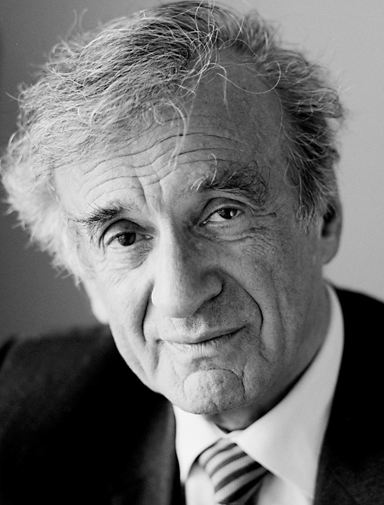
Elie Wiesel
Eliezer Wiesel (b. 1928) was born in Romania in a home that regularly spoke Hungarian, German, Romanian, and Yiddish. During the Holocaust he suffered in multiple labour and concentration camps, including Buchenwald and Auschwitz, and lost both parents and a younger sister. After the war, he resettled in Paris, studied at the Sarbonne, and worked as a journalist. In 1949, Wiesel became the Paris correspondent (later the international correspondent) for Yediot Ahronot. Though originally not wanting to write at all about the horrors of the Holocaust, he was convinced by a friend and published Night in 1958 – a shortened French version of his 900-page memoir in Yiddish. Though it took a while to hit the mainstream, the book now sells hundreds of thousands of copies every year and has been translated into 30 languages. Wiesel has subsequently authored many more publications, and has become an internationally-renowned speaker. In 1986, he won the Nobel Peace Prize for his efforts against racism, violence, and genocide, and was called a “messenger to mankind”. He has also won the Presidential Medal of Freedom, the Congressional Gold Medal, and was knighted, among many other awards. He has even been nominated as President of Israel, but did not wish to take up the post. Wiesel has taught at Boston and Columbia Universities, the City University of New York, and served as a visiting scholar at Yale. He has spent a great deal of his life as a political activist for international causes. He stood strongly against apartheid South Africa and raised support for intervention during the Bosnian genocide, and more recently in Darfur. He has assisted the plight of Kurds, Native Americans, Argentinian Desaparecidos, as well as Soviet and Ethiopian Jewry. Wiesel remains a vocal supporter of Israel, and Jerusalem as its undivided capital. For the past 58 years, he has lived in the US and to this day has authored 57 books.
UPDATE: Sadly, Elie Wiesel passed away on July 2, 2016.
Words of the Week
For me, the Jew that I am, Jerusalem is above politics. It is mentioned more than six hundred times in Scripture – and not a single time in the Koran.
– Elie Wiesel
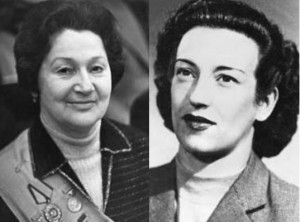
 Feigele Peltel (1921-2012) was born in Warsaw, Poland. At 21 she joined the Jewish Combat Organization. Using her “Aryan” looks and fluency in Polish, she was able to pose as a Pole and come in and out of the Warsaw Ghetto. Through this, she smuggled weapons and supplies in, while saving countless children (and adults) by bringing them out of the ghetto. Her code name was ‘Vladka’, which she later adopted as her legal name. She also worked as a recruiting agent to bring more people into the resistance. One of these was Benjamin Meed, whom she would later marry in the U.S. Together they were among the key organizers of the infamous Warsaw Ghetto Uprising. Vladka wrote a popular book about her experiences, and along with her husband, continued to work in Holocaust education for the rest of her life.
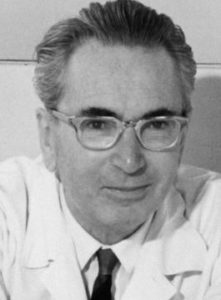 Meanwhile, Viktor Emil Frankl (1905-1997) was a distinguished psychiatrist and neurologist in Austria. He showed a talent for psychology at an early age, and provided psychoanalysis for high school students free of charge while in med school. He later worked in the dreaded “Suicide Pavilion” where he treated over 30,000 women at risk for suicide. After the Nazi takeover, Frankl was first demoted, then imprisoned, and spent three years in concentration camps. He used these experiences to develop a new philosophy of psychology, described in his world-famous book Man’s Search for Meaning (originally titled Saying Yes to Life in Spite of Everything). Frankl founded logotherapy, based on the belief that the central motivating force in humans is to find meaning in life, and most problems stem from this deficiency. Frankl revolutionized the field of psychology, wrote several highly-acclaimed books, and won multiple prestigious awards. Interestingly, he proposed that just as there is a Statue of Liberty on the East Coast, there should be a Statue of Responsibility on the West Coast. Plans are now in the works to build