Tag Archives: Aliyah

Jew of the Week: Dr. Malka Schaps

Dr. Schaps

Dr. Schaps

Mary Elizabeth Kramer was born in Ohio and grew up attending church and Christian Sunday school. By high school, she was drawn to atheism and secularism, but ultimately found no solace in those philosophies either. While in university majoring in mathematics, she found herself exploring various religions. Studying in Germany one semester, she had an inexplicable yearning to attend a Passover seder, and there met an Australian rabbi with whom she continued learning, eventually undergoing a proper Orthodox Jewish conversion (and taking the name Malka). Back in college, she met her future husband – David Schaps – and both went on to earn PhDs at Harvard. The new couple then moved to Israel to teach, had two kids and two foster children. Malka Schaps joined Bar-Ilan University’s Department of Exact Sciences, researching advanced quantum spin representations, in addition to founding and running a financial math program. Meanwhile, Schaps has written a handful of popular, best-selling novels under the pen name “Rachel Pomerantz”. Despite being deeply involved in the scientific community, her faith has only strengthened, and she has said, “I always point out that the study of mathematics shares something in common with Judaism. They both seek to discern a greater order of things and the objective truth.” Recently, she was elected to be Dean of the Department of Exact Sciences at Bar-Ilan, making her the first Orthodox woman in the world to hold such a post. Schaps lives with her family in Bnei Brak.


Words of the Week

Why was the Torah given in the desert? For if it were given in the Land of Israel, the residents of the Land of Israel would say, “It is ours”; and if it were given in some other place, the residents of that place would say, “It is ours.” Therefore it was given in the wilderness, so that anyone who wishes to acquire it may acquire it.
– Mechilta D’Rashbi
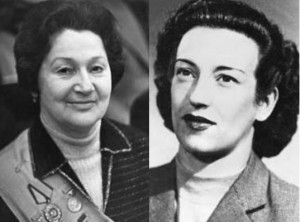
Jews of the Week: Keleti and Gorokhovskaya

Gorokhovskaya and Keleti

Agnes Keleti (b. 1921) was born in Budapest and was Hungary’s national gymnastics champion by age 16. Shortly after, World War II began, forcing Keleti to go into hiding. Much of her family, including her father, were killed in the Holocaust. Keleti survived by posing as a Christian villager. After the war, she began training once more, but had to overcome injuries that prevented her from competing. Determined to go on, she qualified for the 1952 Helsinki Olympics, and won 4 medals, including a gold. Keleti returned to the Olympics in 1956, winning 6 more medals, 3 of which were gold. Being 35 years old at the time made her the oldest-ever gold medal winner in her sport. Her ten total medals makes her among the most decorated female athletes of all time. She also won at the 1954 World Championship. After the Soviet Union’s invasion of Hungary in 1956, Keleti immigrated to Israel, where she still lives today.

A very similar story is that of Maria Gorokhovskaya. Like Keleti, she was born in 1921 (in Ukraine) and took up gymnastics at a young age. After surviving the war, she also competed at the 1952 Helsinki Games, winning 2 golds and 5 silvers. Her 7 medals in one Olympiad is still a world record. Like Keleti, Gorokhovskaya won at the 1954 World Championships, too. With the collapse of the Soviet Union, she made aliyah to Israel in 1990. Both Keleti and Gorokhovskaya have been inducted in the Jewish Sports Hall of Fame. In addition, Keleti has been inducted to the Hungarian and Gymnastics Halls of Fame.

Words of the Week

Everything that is for the sake of God should be of the best and most beautiful… When one feeds the hungry, one should feed them of the best and sweetest of one’s table. When one clothes the naked, one should clothe them with the finest of one’s clothes.
– Maimonides

Jew of the Week: Golda Meir

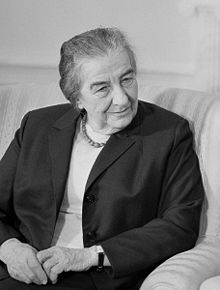
Golda Meir

Golda Meir

Golda Mabovitch (1898-1978) was born in Ukraine and moved with her family to Milwaukee when she was 7 years old. A leader from her youth, she raised funds to pay for her classmates’ textbooks while in elementary school, and ran her parents’ grocery store in their absence. At 14, Golda rebelled against her mother’s wishes to abandon her studies and get married. Instead, she fled to Denver to live with her older sister. There she was first exposed to Zionism, and met her husband Morris Meyerson, from whom she took the last name, later shortening it to Golda Meir. She only married him with the promise that they would move to Israel. After working as a teacher for a few years, Meir finally made aliyah in 1921, joining a kibbutz where she worked on farms and chicken coops. Recognizing her leadership, the kibbutz appointed her their representative to the Histadrut (Federation of Labour). Meir rose through the ranks, eventually becoming head of the Jewish Agency and chief negotiator with the British Mandate. In 1948, she single-handedly raised $50 million for Israel to purchase arms in the wake of war. Ben-Gurion famously said that this was the money that “made the State possible”. She was one of 24 signatories of the Declaration of Independence, and the first person to carry an Israeli passport. Meir served as Labour Minister, and then Foreign Minister, until retiring in 1966 due to lymphoma. But she came back three years later, aged 72, to become Israel’s Prime Minister. She was Israel’s “iron lady” during the Yom Kippur War, maneuvering a victory against all odds. Nonetheless, she took the blame for the war and resigned. She succumbed to lymphoma shortly after. A winner of the Israel Prize, and voted to the list of greatest Israelis, her maxims are often quoted. Meir once said: “Pessimism is a luxury that a Jew can never allow himself.”

Words of the Week

Ten measures of speech were given to the world, and nine of them were granted to women.
– Talmud, Kiddushin 49b