Jews of the Week: Volodymyr Groysman and Volodymyr Zelensky

Ukraine’s President and Prime Minister
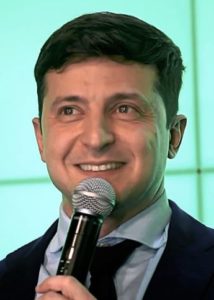
Volodymyr Zelensky

Volodymyr Oleksandrovych Zelensky (b. 1978) was born in Ukraine to Jewish parents. As a child, he spent four years living in Mongolia where his father worked. While studying at school, he joined his local comedy troupe, and eventually made it to Ukraine’s national comedy team. They won the KVN comedy championship in 1997 (a pretty big deal in the former Soviet Union) and Zelensky, despite having a law degree, decided to pursue a full-time career in comedy. He created a new troupe, Kvartal 95, which continued to perform across Russia and Ukraine, and eventually got their own TV show in 2003. Five years later, Zelensky made it to the big screen, starring in his first feature film. In 2015, Zelensky’s Kvartal 95 produced a new series, Servant of the People, with Zelensky in the lead role playing a young high school teacher who surprisingly becomes Ukraine’s president. The show was hugely popular, and was renewed for two more seasons, and a film. Last year, Zelensky registered “Servant of the People” as a political party in Ukraine, and actually ran in its real-life elections earlier this year. As he toured the country during his campaign, he also continued to perform with Kvartal 95. Incredibly, Zelensky won the election in a landslide (winning 73% of the vote), and will be inaugurated this week as Ukraine’s 6th president. It is hoped that he will strengthen Ukraine’s economy, fight corruption, bring calm to the civil wars in the country’s east, and work towards greater independence from Russia. While it is too early to tell what kind of president he will be, many are already predicting that unfortunately (as has happened too often in history) if Zelensky will turn out to be a successful president he will be hailed as a great Ukrainian, and if he fails, they will call him a traitorous Jew.
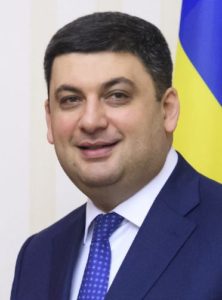
Volodymyr Groysman

While Zelensky will be Ukraine’s first Jewish president, he is preceded by Ukraine’s first Jewish prime minister, Volodymyr Borysovych Groysman (b. 1978). Groysman was born in the town of Vinnytsia, and worked in his father’s business growing up. While still studying law, he ran for city council in 2002 and won a seat. Shortly after graduating, he joined the Our Ukraine party, and the following year was elected mayor of Vinnytsia. Being just 28 years old, that made him the youngest mayor in Ukraine’s history. He was praised for his tremendous work and won re-election with 78% of the vote in 2010. Four years later, Groysman was appointed as Ukraine’s Minister of Regional Development, and several months after that, made chairman of the parliament. His popularity continued to rise quickly, and when the prime minister resigned in 2016 over corruption allegations, parliament elected Groysman as his replacement. Aged 38 years, he became Ukraine’s youngest-ever prime minister, and its first Jewish prime minister. He has worked diligently to combat corruption, and also supports greater integration with the West. Ukraine is now the only country in the world outside of Israel to have both a Jewish prime minister and a Jewish president.

Words of the Week

A person’s main vitality lies in his intellect. One who is not using his intellect to its full potential is considered asleep. Many people who seem to be alive are in fact sleeping their lives away.
– Rabbi Nachman of Breslov (Likutey Moharan I, 60:6)
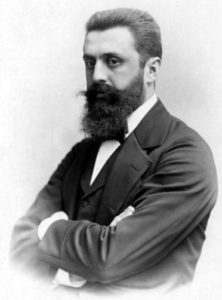
Jew of the Week: Theodor Herzl

Israel’s “Spiritual” Founding Father

Theodor Herzl

Theodor Binyamin Ze’ev Herzl (1860-1904) was born in what is now Budapest, Hungary to Ashkenazi Jewish parents with mixed Sephardic heritage. He was a descendant of the great Spanish rabbi and kabbalist Yosef Taitazak. Herzl first wished to be a scientist and engineer, then switched to law and journalism. In his youth, he was ashamed of the many impoverished and uneducated Jews in Hungary, and was inspired by the Germans whom he felt were the most civilized and cultured of peoples. During his time at the University of Vienna, he was a member of a German nationalist club, but left because of their rampant anti-Semitism. After a brief law career, Herzl became a journalist for a Viennese paper. In 1894, he was sent to cover the Dreyfus Affair where a French-Jewish military officer was falsely accused of treason by anti-Semites, and heard the masses chant “Death to the Jews”. While this is often cited as the moment that awoke him to the plight of the Jews, a more likely factor was what happened at the same time back home in Vienna. The virulently anti-Semitic Kart Lueger was elected mayor – this was the man whom Hitler would later credit as being his major inspiration. Although Herzl once believed that Jews should assimilate and become Germans, he soon realized that the Germans were not as civilized as he thought, and that the Jew would never be accepted in European society. Immersing himself in Jewish and early Zionist literature (especially the work of the great Sephardic rabbi and mystic Yehuda Alkali), he came to understand that the only solution for the Jews was not to abandon their heritage, but to embrace it forcefully and return to their Promised Land (or some other land if that didn’t work). He wrote: “Zionism is first and foremost a return to Judaism.”

Herzl got to work and drafted Der Judenstaat, his manual for “The Jewish State”. It was published in early 1896 and quickly became a bestseller. Meanwhile, Herzl succeeded in arranging a meeting with the German emperor, injecting a huge boost of credibility to his campaign. The following month, Der Judenstaat was published in English, and a month after that Herzl met with the Grand Vizier of the Ottoman Empire, who awarded him a medal. Herzl continued traveling, speaking, and meeting with dignitaries and Jewish communities. In 1897 he spent much of his own savings to found a Zionist newspaper and to organize the First Zionist Congress, where he was elected its president. It should be noted that Herzl had many opponents, including assimilated Western European Jews, those that had entered the European nobility, most of the wealthy Jews and bankers who lived in Europe comfortably, as well as the Ultra-Orthodox Jews who distrusted his secular leadership. Nonetheless, he charged onwards, believing that “The Jews who wish for a State will have it.” Herzl continued negotiating with the British, the Turks, and the Russians. He traveled to Israel for the first time in 1898, and once more met the German emperor there for discussions. He also traveled to Russia to try to ease the plight of the Jews and end the pogroms. Meanwhile, he worked on a novel to describe his vision more romantically, and published Altneuland in 1902, which also became a bestseller. When translated into Hebrew by Nahum Sokolow, he chose to title the book Tel Aviv, based on a verse from the Tanakh (Ezekiel 3:15). The name would, of course, later be adopted for Israel’s largest city. Herzl met with the Pope in early 1904, famously refusing to kneel before him or kiss his hand as was required. The Pope refused to help the Jews unless they all converted to Christianity, which Herzl quickly rejected. The meeting lasted less than a half hour. (The next Pope would reverse the Church’s position in 1917 and support the Zionist cause.) Herzl had been battling a heart condition for quite a while, and unfortunately succumbed to it in the summer of 1904. He didn’t live to see his dream fulfilled, but on the 5th of Iyar in 1948, the State of Israel became a reality, with David Ben-Gurion proclaiming the rebirth of an independent Jewish state in the Holy Land, with a portrait of Herzl behind him. The city of Herzliya in Israel is named after him, and the 10th of Iyar (next Wednesday), is a minor holiday in Israel called Herzl Day. Happy Yom Ha’Atzmaut!

A Secret History of Zionism

Words of the Week

…I believe that a wondrous generation of Jews will spring into existence. The Maccabees will rise again… We shall live at last as free men on our own soil, and die peacefully in our own homes. The world will be freed by our liberty, enriched by our wealth, magnified by our greatness. And whatever we attempt there to accomplish for our own welfare, will react powerfully and beneficially for the good of humanity.
– Theodor Herzl, Der Judenstaat

Jew of the Week: Beate Sirota Gordon

The Woman Who Wrote Japan’s Constitution

Beate Sirota Gordon helped draft the Japanese constitution, and transformed Japanese society, when she was just 22 years old.

Beate Sirota (1923-2012) was born in Vienna, the daughter of Russian-Ukrainian Jewish immigrants. When she was five years old, her father, a popular musician, accepted a position to teach music at what is now the Tokyo University of the Arts. The family moved to Japan, where Sirota studied in German and American schools. At 16, she went to college in California and got a degree in languages, speaking English, German, French, Russian, and Japanese fluently. When World War II broke out, Sirota was one of just a handful of (non-Japanese) people in America who could speak Japanese, and went to work for the Office of War Information. Her main job was to monitor Japanese radio signals and translate their broadcasts. During this time, she had no contact with her parents who were still living in Japan. As soon as the war ended she volunteered to go to Japan as a US Army translator, hoping to find her parents (she did). She would become the first civilian woman admitted to the country. In 1946, the Americans started working on a new constitution for Japan and Sirota (the only woman on the committee) was tasked with writing the section on civil rights. She made it a priority to ensure that Japanese society would finally allow equality for all, especially better conditions for women who still had no rights in the country. Sirota personally drafted Article 14 (“All of the people are equal under the law and there shall be no discrimination in political, economic or social relations because of race, creed, sex, social status or family origin…”) and Article 24 (“Marriage shall be based only on the mutual consent of both sexes and it shall be maintained through mutual cooperation with the equal rights of husband and wife…”) Despite reservations from both the Japanese and American negotiators (who felt she was giving Japanese women more rights than even American woman had), Sirota eventually convinced her counterparts to include the clauses. She is therefore credited with being the central force for bringing social equality and women’s rights to Japan.

During her time working on the constitution, Sirota met her future husband, Lt. Joseph Gordon. They returned to the US and settled in New York. After briefly working for TIME magazine, Sirota pursed her passion for art, music, and dance. Meanwhile, she worked at the Japan Society helping Japanese students and immigrants (one of whom was Yoko Ono). Sirota played a large role in introducing Japanese (and Asian) music and art to the West. By 1970, she was Director of Performing Arts for the Asia Society, and began to travel all over Asia to remote communities in search of traditional art forms. She would then invite these artists on tours to the West. All in all, Sirota organized 39 tours in 16 countries. In the US alone, her shows were seen by 1.5 million people in 400 cities. She also made five films and multiple television programs about Asian art, and recorded 8 albums of music. For all of her tremendous work, Sirota received dozens of awards, including the prestigious Order of the Sacred Treasure from the Japanese government. In Japan, two films have been made about her life. In 1995, Sirota published a memoir in Japanese, followed by an English version in 1998, titled The Only Woman in the Room. Today, she is one of Japanese greatest feminist icons.

In Memory of Lori Kaye, 60, “Who Thought of Others Before Herself”

A Mystical Map of Your Soul

Words of the Week

Until now you have focused on what you need from God; it’s about time you asked, “What is needed of me?”
– Rabbi Schneur Zalman of Liadi (1745-1813)