Jews of the Week: Esther Brandeau and Esther Abrahams

First Jews in Canada and Australia

Esther Abrahams, first Jew in Australia

Esther Abrahams (c. 1767-1846) was born in London, England to a poor Jewish family. As a struggling pregnant teenager, she was arrested for petty theft and sentenced to seven years in the new penal colony of Australia. Two months later, Esther and her baby were aboard the First Fleet: 11 ships of settlers, colonists, and prisoners headed for Australia. She arrived in Sydney in January of 1788, becoming the first Jewish person on the continent. During the voyage, she had met a British officer named George Johnston, and the two fell in love. They married and had seven children. In 1808, her husband led the Rum Rebellion in overthrowing the local British governor. Johnston became the new lieutenant-governor of the colony. While he was away for four years to defend himself against charges of mutiny, Esther ran his vast estate and business operations. Among her descendants are a number of notable Australian military and political leaders.

On the other side of the world, another Esther was the first Jew to set foot in Canada. Esther Brandeau (b. 1718) was born near Bayonne, France. To escape intense antisemitic persecution in France at the time, she dressed up as a Catholic man and got hired as a sailor for a voyage to the French colony of Quebec. Eventually, her true identity was discovered and she was arrested. Jews were forbidden from settling in Catholic Quebec at the time, and her desperate pleas for refuge were rejected. She was given an option to convert or be expelled. Brandeau chose the latter, and was shipped back to France. What happened to her afterwards is unknown. Her story has inspired at least three different novels and a play.

Words of the Week

Israel became the people conceived in slavery so that it would never cease to long for liberty…
Rabbi Jonathan Sacks

Jew of the Week: Two-Gun Cohen

The Jewish General Revered in China and Taiwan

Moszek Abram Miączyn (1887-1970) was born in Poland to a deeply religious Jewish family. When he was two years old, the family moved to England and changed their last name to Cohen. Growing up in poverty, he got into a lot of trouble and was sent to a Rothschild-funded school for wayward youth. In 1905, his parents sent him to Canada to work on a farm, hoping it would strengthen and mature the young man. Now known as Morris Cohen, he became a typical “cowboy” and, when not raising livestock, spent his time in saloons, playing cards, shooting guns, and ending up in jail on several occasions. Cohen befriended Chinese immigrants working on the Canadian Pacific Railway. At the time, racism and abuse against the Chinese was rampant, and Cohen soon gained a reputation as the only white man who stood up for them. This eventually brought him an invitation from Sun Yat-sen, renowned philosopher and freedom fighter, who led the resistance in overthrowing the Chinese monarchy and who is today revered as a founding father in both China and Taiwan. Cohen and Sun Yat-sen became close friends. Meanwhile, Cohen enlisted in the military during World War I, fighting valiantly and rising to the rank of sergeant. When he was shot and injured in his right arm, he decided he needed to learn how to shoot with his left, too, and carried a revolver on both sides, earning the nickname “Two-Gun Cohen”. Upon his return to Canada, Cohen found himself without money or work. He headed to China and rejoined Sun Yat-sen, becoming his advisor and aide-de-camp. He helped in building China’s railways, and at the same time trained Sun Yat-sen’s revolutionary troops. Cohen became Sun Yat-sen’s personal bodyguard, and was given the Chinese name Ma Kun. After Sun Yat-sen’s passing, Cohen continued to work for the Kuomintang (the Chinese Nationalist Party), and was given the rank of major-general in the Revolutionary Army. During World War II, Cohen fought alongside the Chinese against the Japanese. He was captured in one battle, imprisoned and tortured, and was only freed in December 1943 in a prisoner exchange. He settled in Montreal and got married. In 1947, as the UN vote on the partition of Israel approached, Cohen heard that China planned to oppose, so he reached out to his contacts and made sure the Chinese government would abstain, which they did. Cohen remained neutral during the China-Taiwan split in 1949, and was one of the few people in the world permitted to travel directly between the two countries, as he was admired in both. At his funeral in Manchester, England’s Blackley Jewish Cemetery in 1970, delegations from both China and Taiwan arrived, marking one of the rare occasions when the two governments appeared together in public. Cohen’s life inspired at least three films, including The Gunrunner, where Cohen’s character was played by Kevin Costner.

Words of the Week

Since the Exodus, freedom has always spoken with a Hebrew accent.
– Heinrich Heine

Jew of the Week: Abraham Maslow

Founder of Positive Psychology

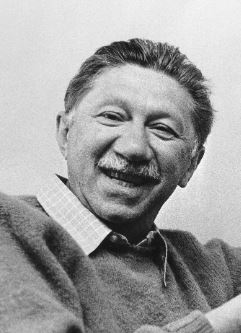
Abraham Harold Maslow (1908-1970) was born in Brooklyn to Jewish-Russian immigrant parents from Kiev. Maslow grew up in poverty and faced a great deal of antisemitism. He wasn’t happy at home either, and spent most of his time at the library reading. In high school, he was the editor of the school’s Latin and physics magazines. Maslow went on to study at City College of New York, and then took up psychology at the University of Wisconsin, where he did experiments and studies on primate behaviour. He moved on to Columbia University, where he worked with Alfred Adler, then taught at Brooklyn College and later at Brandeis University. After World War II, distraught by the Holocaust and the ravages of war, he switched his focus to mental health and human potential, founding a new branch of psychology called humanistic psychology, or positive psychology. The core idea behind humanistic psychology is that every person has the innate ability to grow, heal, and attain happiness and self-actualization. The job of the therapist is only to remove the obstacles that are holding a person back from achieving those goals. As Maslow described it: “Freud supplied us the sick half of psychology and we must now fill it out with the healthy half.” This inspired other psychologists and researchers like Carl Rogers, who pioneered client-centered therapy, and Martin Seligman, who coined “learned helplessness” and proposed Well-Being Theory. The most famous result of Maslow’s work was the Hierarchy of Needs, a pyramid that shows the five major necessities of a human being. At the bottom are the basic physiological needs which are most pressing, but provide the least happiness and satisfaction in the long term. At the top is self-actualization, living a harmonious life of purpose and meaning, which is the most difficult to attain but provides the highest degree of happiness and lasting satisfaction. In 1961, Maslow cofounded the Journal of Humanistic Psychology. His most popular book was The Psychology of Science, where he coined the well-known saying that “if all you have is a hammer, everything looks like a nail”. Maslow was voted Humanist of the Year in 1967, and has been ranked among the top 10 greatest and most-cited psychologists of all time.

Archaeologists Discover Tablet with Earliest Mention of God’s Name

10 Facts You Should Know About Ruth

Maslow’s Hierarchy of Needs

Words of the Week

Of all tyrannies, a tyranny sincerely exercised for the good of its victims may be the most oppressive. It would be better to live under robber barons than under omnipotent moral busybodies. The robber baron’s cruelty may sometimes sleep, his cupidity may at some point be satiated; but those who torment us for our own good will torment us without end for they do so with the approval of their own conscience.
– CS Lewis