The Man Who Made Lincoln President
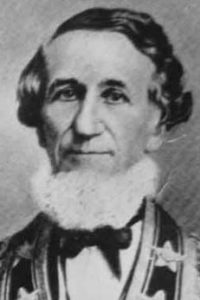 Abraham Jonas (1801-1864) was born in England to a religious Jewish family. He moved with his brothers to Cincinnati in 1819, and they were the first Jewish family to journey west to the new frontier beyond the Allegheny Mountains. They were also the founders of the first synagogue in Ohio, Congregation B’nai Israel. Jonas married Lucy Seixas, the daughter of Gershom Mendes Seixas, the first rabbi born in America. After she passed away, he relocated to Kentucky, remarried, and opened a general store. Having been involved with the Freemasons back in Cincinnati, Jonas opened a new Masonic Lodge in Kentucky. He became its master in 1832. Around the same time, he was elected to the Kentucky State Legislature and served a four year term. After this, Jonas moved to Illinois and opened a new general store, as well as a carriage business, before going to study law. He and his brothers started a newspaper, and built another synagogue, Congregation B’nai Abraham. (Jonas’ law office was a room inside the synagogue.) In 1840, Jonas established Illinois’ Grand Masonic Lodge and was elected its Grand Master. Two years later, he joined the Illinois State Legislature, and there met Abraham Lincoln. The two became very close friends. When their Whig Party fell apart, both Abrahams were among the co-founders of the new Republican Party. It was Jonas who later inspired Lincoln to run for president, and campaigned on his behalf. Jonas was a noted abolitionist, and vehemently opposed the 1854 Kansas-Nebraska Act which allowed slavery in new Western states. In fact, Jonas chaired the committee which organized the now-famous Lincoln-Douglas Debates, where Abraham Lincoln made his case against slavery. In 1858, when leaders of the Republican Party were deciding whom to nominate as their next candidate for president, Henry Asbury suggest Lincoln, whom the others rejected immediately. At this point, Jonas spoke up and turned the tables. Still, at the party’s Illinois convention in May 1860, it seemed clear that William Seward would be nominated. Jonas stepped in yet again, and ensured Lincoln’s nomination. Less than a year later, Lincoln was president. He appointed Jonas as the postmaster of Quincy, Illinois. Jonas continued to support and advice Lincoln until his last days. Of Jonas’ five sons, two fought with the Confederate Army, which grieved him greatly. He fell terribly ill in the midst of the Civil War. As he lay on his death bed in 1864, his son Charles was captured and imprisoned. President Lincoln wrote a personal order to release Charles so that he could be alongside his father. Jonas died that same day. He played a critical role in ensuring the survival of Jewish life in America. He was also a key founding member of the Republican Party, and there is little doubt that without him Abraham Lincoln (who has been voted America’s greatest president by both citizens and political scientists) would have never become president. Not surprisingly, Jonas is the only person that Lincoln ever described as “one of my most valued friends”.
Lincoln and the Jews: 10 Fascinating Facts
Words of the Week
The American Jewish community is wonderful. While you cannot tell them to do anything, you can teach them to do everything.
– The Lubavitcher Rebbe, to Herman Wouk