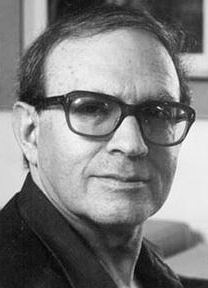
Chess Master, Musician, Submarine Tycoon
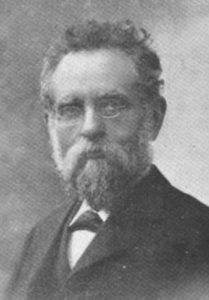
Isaac Rice
Isaac Leopold Rice (1850-1915) was born in Bavaria to a German-Jewish family, and grew up in Philadelphia. At 19, he went back to Europe and studied music at the National Conservatory of Paris. At the same time, he was a European correspondent for the Philadelphia Evening Bulletin, and regularly wrote newspaper articles. After three years, Rice briefly moved to England and became a music teacher. He was an avid chess player and won a UK chess championship in Manchester. Rice then moved to New York and wrote his first book, the philosophical “What is Music?” He taught music classes for ten hours a day in order to support his struggling parents and siblings, and spent several more hours composing new music. In 1878 he enrolled in Columbia Law and graduated at the top of his class two years later. Rice worked primarily with railroad companies, and over the next decade became the most famous railroad lawyer in America. Meanwhile, he co-founded Columbia’s school of political science, and taught the subject (along with law and economics) for four years. He also established Forum Magazine, and was a regular contributor for decades. Rice was fascinated by electricity and its potential. In 1892 he bought out the failing Electro-Dynamic Company, producer of motors and generators. He then founded the Electric Vehicle Company, and is thought to be the first person in New York to have a car, bringing another dozen motorized cabs to operate in the city for the first time. In 1897, Rice bought the Electric Storage Battery Company and the Holland Torpedo Boat Company, creating his new Electric Boat Company. Rice secured a contract with the US government to build America’s first submarines (designed by John Philip Holland). He went on to supply the US Navy with 85 submarines and 722 submarine chasers, which were instrumental in World War I, as were his 580 motor boats for the British Royal Navy. Rice sold his Electric Boat Company for $2 million several months before he passed away. His companies later formed General Dynamics, today one of the largest military contractors in the world, employing over 100,000 people, and still the main supplier of the Navy’s submarines. (The company’s most famous creation: the F-16 fighter jet.) Rice continued to play chess and host tournaments until his last days. He is credited with playing a key role in boosting the popularity of chess in America. Rice was president of the Manhattan Chess Club, and discovered a classic opening move of chess that is named after him (the Rice Gambit). His large New York home, which he built in 1903, is an official historical landmark, and currently houses a yeshiva.
Amazing Discovery of Biblical Joseph’s Statue in Egypt
Words of the Week
This is a fight for the homeland – it is either us or the Israelis. There is no middle road. The Jews of Palestine will have to leave. We will facilitate their departure to their former homes. Any of the old Palestine Jewish population who survive may stay, but it is my impression that none of them will survive.
– former PLO chairman Ahmed Shukairy
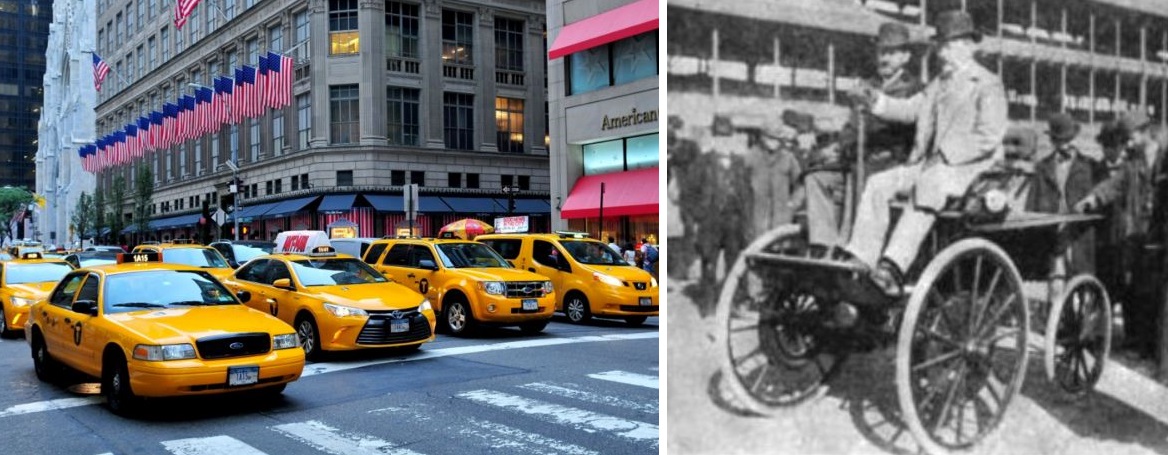
New York City is famous for its cabs. It all began with a set of motorized cabs, like the Electrobat on the right (designed by Morris and Salom) – first introduced by Isaac Rice.
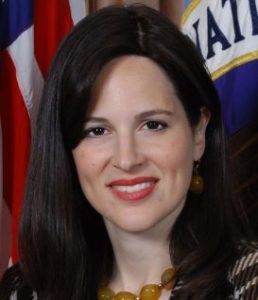 Chani Anne Neuberger (b. 1976) was born in Brooklyn to a Hasidic Jewish family with roots in Hungary. She grew up speaking Yiddish and went to school at Bais Yaakov of Boro Park. She studied at Touro College, then earned an MBA from Columbia University. A professor suggested that she apply for the prestigious White House Fellowship, and she did a couple of years later. She was selected and – to her surprise – instead of going to the Treasury Department she was posted to the Department of Defense. From there, she got a job working for the Secretary of the Navy, and eventually became the US Navy’s deputy chief management officer. In 2009, Neuberger was posted to the new Cyber Command team of the NSA (National Security Agency). Her work was impressive, and after the Snowden leaks of 2013, she was appointed the NSA’s first chief risk officer. Neuberger also served as assistant deputy director of operations, and most recently oversaw security during the 2018 US Midterm elections. Earlier this week, Neuberger was named the NSA’s new head of the Cybersecurity Directorate. She sits on the NSA’s board of directors, and is one of its highest-ranking women. Neuberger finds inspiration for her work in her own family history: Seven of her eight great-grandparents were killed in the Holocaust, her grandparents were survivors, and in 1976 her parents were hostages on the Air France plane that was hijacked by terrorists and diverted to Entebbe. Outside of government, Neuberger runs a charity called Sister to Sister which helps single mothers in Orthodox Jewish communities across the US and Canada. The organization has over 1000 members and volunteers. Neuberger remains devoutly religious, and has said that sometimes her coworkers remind her that sunset is approaching so that she can make it home for Shabbat. Her advice to religious Jews: “learn to navigate the secular world as a frum [religious] Jew without apologizing, without abandoning your principles, but also with a sense of how and when to be flexible.”