Category Archives: Business & Finance

Jews in the World of Business and Finance

Jew of the Week: Adolph Zukor

“Napoleon of Motion Pictures”

Adolph Zukor

Adolph Zukor

Adolph Zukor (1873-1976) was born in Hungary, and orphaned by the time he was just 7 years old. He was raised by his uncle, the local rabbi, and once had dreams of becoming a rabbi himself. At the young age of 16, he set out on his own and immigrated to the US with just $40. He first got a job sweeping floors for $2 a week at an upholstery store, and then apprenticed as a fur-maker. He set off on his own once again when he was 20, heading to Chicago to start his own fur business with a friend. Zukor was soon a noted clothing designer, and a wealthy man. In 1903, he partnered with his cousin to open an arcade. Of all the entertainment at his arcade, Zukor was most fascinated by movies, and decided to focus his efforts on the new medium. By 1912, he founded his own film distribution company, ‘Famous Players’, which soon premiered the first feature-length film in America. By 1919, Zukor had sole control of his company, later to be known as Paramount Pictures, and owned hundreds of theatres across the country. He also made it the first company to both produce films and distribute them, as well as show them at its own theatres, making Paramount a revolutionary film industry giant. Zukor personally signed some of Hollywood’s earliest stars, though he himself was not a fan of the spotlight, and was a humble, modest businessman. At one point, his Publix movie theatre chain had over 2000 screens across the country, and was showing over 60 new Paramount flicks each year. Unfortunately, the Great Depression hit the film industry hard, and Paramount went bankrupt. Despite no longer being the company’s president, Zukor helped to save Paramount, and continued to play a critical role in the company until 1959, when he officially retired. He remained on the board as an honourary chairman until his passing at the age of 103 – of natural causes, while taking a nap. (He once said, “If I’d known I was going to live this long, I’d have taken better care of myself.”) Zukor continues to be remembered as the greatest of Hollywood pioneers, and has been called ‘the Napoleon of motion pictures’, and ‘the true founding mogul of Hollywood’.

Words of the Week

Creativity is intelligence having fun.
– Albert Einstein

Jew of the Week: George Weidenfeld

The Lord Weidenfeld, Baron of Chelsea

George Weidenfeld (Credit: Getty Images)

George Weidenfeld (Credit: Getty Images)

Arthur George Weidenfeld (1919-2016) was born in Vienna. When Germany annexed Austria in 1938, Weidenfeld fled to London with the help of a Christian family. He started working for the BBC, and several years later became a political commentator and writer. In 1948, he co-founded a publishing company with Nigel Nicolson. Their most famous publication was Nabokov’s Lolita. By 1985, their company was large enough to acquire the American publisher Grove Press. In turn, they were bought out in 1991 by Orion Publishing. Weidenfeld continued to write throughout the years, in both English and German (all in all, he knew 7 languages). Meanwhile, he played a key role in both the Jewish community and in the world of philanthropy at large. Wishing to repay his debt to the Christian family that helped him escape the Nazis, Weidenfeld started a campaign to rescue 20,000 Christians victimized by the Syrian Civil War. The first flight of 150 Christian refugees landed in Poland last summer through the Weidenfeld Safe Havens Fund, which also provided them with over a year’s worth of financial support. On the side, Weidenfeld served as a political adviser to many leaders, including former British prime minister Tony Blair, and was a frequent guest of Pope John Paul II. Back in 1949, he was Chief of Cabinet for Israel’s first president, Chaim Weizmann. In Israel, he chaired both Ben Gurion University and the Weizmann Institute. Weidenfeld was knighted in 1969, and later made Baron Weidenfeld of Chelsea, earning a seat on the House of Lords, where he often participated in debate. Sadly, Weidenfeld passed away last week, and was laid to rest in Jerusalem.

Words of the Week

Trials are medicines which our gracious and wise Physician gives because we need them; and the proportions, the frequency, and weight of them, to what the case requires. Let us trust His skill and thank Him for the prescription.
– Isaac Newton

Jews of the Week: Joe and Ben Weider

Godfathers of Bodybuilding

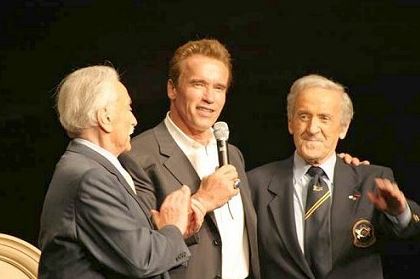
Weider Brothers with Arnold Schwarznegger (Credit: ibffpro.com)

Weider Brothers with Arnold Schwarznegger (Credit: ibffpro.com)

Joseph (1920-2013) and Benjamin (1923-2008) Weider were born to a Polish-Jewish immigrant family in Montreal. Constantly bullied while growing up, they began exercising and lifting weights in their teenage years, making their own equipment out of old car wheels and axles. As their muscles grew, their adversaries disappeared, and the boys’ self-esteem shot up. They decided to share their new passion with others. At 18, Joe started a bodybuilding magazine called Your Physique. By 1943, the magazine had become popular across Canada. A few years later (following Ben’s return from World War II service) the brothers organized the first “Mr. Canada” contest. Ben then went on a mission around the world to spread the art of bodybuilding, after which the brothers established the International Federation of Bodybuilders. By 1952, their magazine had 25 million readers around the globe. Unfortunately, the sport slowly lost popularity, and by the 1960s, the Weiders were looking for a fresh start. They created a new competition, Mr. Olympia, but it initially didn’t bring the success they hoped for. The brothers moved to California, now with a new magazine, Muscle Builder. While in Europe, they met a young bodybuilder, and decided that he would be the image of their new brand. The brothers brought him to California, settled him in, trained him, taught him about business and media, and eventually turned him into one of Hollywood’s greatest: Arnold Schwarzenegger. (In 2006, then-Governor Schwarznegger presented the brothers with a Lifetime Achievement award, and in his speech thanked them for inspiring him, bringing him to America, and skyrocketing his career.) Ultimately, the Weiders would run several more magazines – including Men’s Fitness and a women’s health magazine called Shape – as well as produce their own health products, vitamins, and supplements (Weider Nutrition is considered the first sports nutrition company). From the start, they warned millions of their readers about the dangers of tobacco and alcohol, and refused to publish ads for these products in their magazines. Not surprisingly, the Weiders are credited with bringing greater awareness of healthy living and exercise to the masses. The brothers were also praised for breaking down barriers and allowing blacks, Hispanics, and women into their competitions at a time when it was still considered taboo. Surprisingly, Ben is also a noted historian, specializing in Napoleonic times, and co-writing several books on the subject. He has been awarded the Order of Canada, the French Legion of Honour, and was even nominated for a Nobel Peace Prize. Meanwhile, Joe wrote a couple of books on bodybuilding, and was voted Publisher of the Year in 1983. Along the way, the brothers never abandoned their connection to Judaism, often corresponding with the Lubavitcher Rebbe, and donating generously to Chabad organizations, among many others.

Words of the Week

It is not enough to be busy; so are the ants. The question is: What are we busy about?
– Henry David Thoreau