Tag Archives: World War I

Jew of the Week: Morris Cohen

China’s “Uncrowned Jewish King”
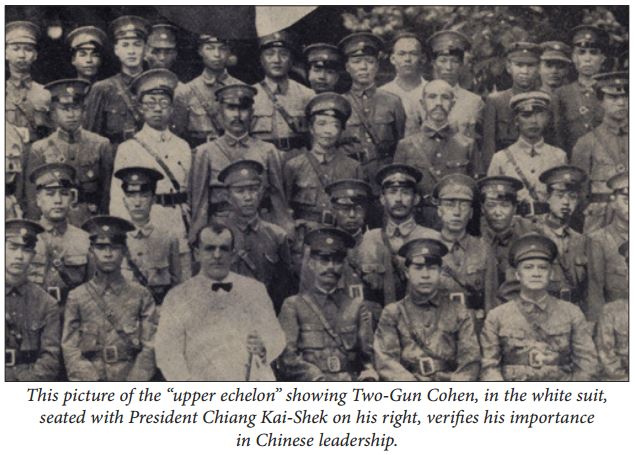
Morris Cohen sitting next to Chinese President Chiang Kai-Shek (Credit: Joe King)

(Credit: Joe King)

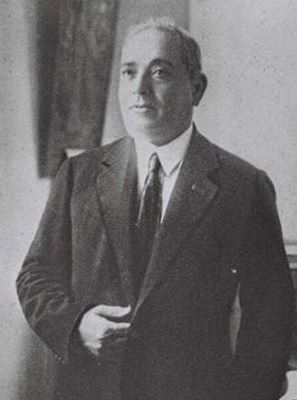
Moshe Morris Abraham Cohen (1887-1970) was born in Poland to a poor Orthodox Jewish family. While he was still an infant, his family fled the pogroms and settled in London, England. Growing up, Cohen often got in trouble so his parents sent him to work on a farm in Saskatchewan, Canada, hoping to mend his ways. There, he learned the value of hard work, in addition to playing cards and shooting guns. He became good friends with Chinese railroad workers, and even defended a Chinese man who was being robbed – a big deal at a time when white people rarely stood up for the Chinese in those days. Cohen’s friends invited him to join the revolutionary party of Dr. Sun Yat-sen, who would become modern China’s founding father and first president. Cohen agreed to train Chinese-Canadians in military combat and helped secure weapons for China’s revolutionary army. Meanwhile, he settled in Edmonton and became a successful real estate broker. Cohen was soon appointed as the province of Alberta’s Commissioner of Oaths. With the outbreak of World War I, he fought valiantly with the Canadian Railway Troops. Finding it hard to make a living in Canada after the war, he moved to China. Cohen was hired by Sun Yat-sen to train his forces, procure arms, and serve as his personal bodyguard. After once taking a bullet while protecting Sun Yat-sen in an assassination attempt, he started carrying two guns, and henceforth was known as “Two-Gun Cohen”, though the Chinese called him Ma Kun, “Clenched Fist”. Following Sun Yat-sen’s death, Cohen continued working for China as a military commander and head of their secret service. During World War II, it was Cohen that proved the Japanese were using poison gas against Chinese civilians. Cohen was captured in battle by Japanese soldiers. He was nearly beaten to death before being freed in a prisoner exchange. Cohen then returned to Canada, settled in Montreal, and finally married. He spent the rest of his life in relative quiet, working as a consultant in various capacities, and often traveling to China. (He had the distinction of being the only person allowed to travel freely between China and Taiwan – as he was friendly with leaders of both nations, despite their antagonism towards each other.) Perhaps his last great act was convincing the Taiwanese not to oppose the UN Partition Plan that gave birth to the State of Israel. Taiwan’s position on the UN Security Council made their vote critical, and they intended to oppose the plan until Cohen stepped in. He also helped to arm the nascent State of Israel in its War of Independence. Cohen’s life inspired two books, as well as the 1936 film The General Died at Dawn, and the 1984 film The Gunrunner, starring Kevin Costner. As a major general in China’s revolutionary army (to this day, the only Westerner to hold such a high rank in the Chinese military), one-time head of China’s secret service, and Sun Yat-sen’s personal aide, Cohen played an instrumental role in the founding of modern China. He was once described as China’s “uncrowned Jewish king”.

Yom Kippur Begins Tonight! Gmar Chatima Tova!

Words of the Week

All lovers of democracy cannot help but support… the movement to restore your wonderful and historic nation which has contributed so much to the civilization of the world and which rightly deserves an honourable place in the family of nations.
Dr. Sun Yat-sen, on his support for the Zionist movement

Jews of the Week: Maurice Druon and Joseph Kessel

Game of Thrones

Kessel

Joseph Kessel

Joseph Kessel (1898-1979) was born in Argentina to a Jewish-Russian family, the son of a doctor from Lithuania. He spent his early childhood in Russia before the family moved to France. Kessel became a pilot and a writer. In the former capacity, he served valiantly in both World Wars, and in the latter, wrote over 20 novels. Many of his novels were translated into a number of languages, and were later adapted into very popular French films. Today, the Prix Joseph-Kessel is among the top literary prizes awarded for French literature. Maurice Druon (1918-2009) was Kessel’s nephew. (He went by his stepfather’s last name). He was born in Paris and raised in Normandy. Like his uncle, Druon became a writer as well. His career was interrupted by World War II, when he fought with the French Resistance, and together with his uncle, wrote the well-known anthem of the Resistance (based on an earlier Russian song).

Druon

Maurice Druon

Following the war, Druon wrote Les Grandes Familles, a bestseller adapted to an equally popular film. Druon would write two sequels to this novel, together with dozens of other important literary works. Among those is the seven-volume Les Rois Maudits (The Accursed Kings). This series was adapted to a TV show in 1972, and again in 2005. It also served as the foundation and inspiration for George R.R. Martin’s A Song of Ice and Fire, which was adapted to the current hit show Game of Thrones. In addition to his writing, Druon was France’s Minister of Cultural Affairs in the 1970s. Both he and his uncle Joseph Kessel were lifelong members of the prestigious ‘Académie française’.

Words of the Week

No problem can be solved from the same level of consciousness that created it.
Albert Einstein

Jew of the Week: Meir Dizengoff

Founder of Tel-Aviv

Meir Dizengoff

Meir Dizengoff

Meir Yankelevich Dizengoff (1861-1936) was born in Bessarabia, a region overlapping parts of modern-day Moldova and Ukraine. After completing his education, he enlisted in the Russian Army, where he served for two years. Dizengoff then settled in Odessa and soon joined a revolutionary group called Narodnaya Volya (“People’s Will”), which sought to overthrow the Tsar and assist the plight of the many impoverished people across the Russian Empire. At the same time, he met several Zionist leaders and joined Hovevei Zion, an organization formed in response to the tragic pogroms of 1881. In 1885, Dizengoff was arrested for his involvement with Narodnaya Volya’s insurgent activities. Upon his release, he moved back to Bessarabia to found a new branch of Hovevei Zion. A couple of years later, Dizengoff enrolled at the University of Paris to study chemical engineering. It was there that he met Edmond James de Rothschild, a member of the French Rothschilds who was an ardent Zionist. Rothschild sent Dizengoff to Israel to set up a bottle-making factory for his family’s wineries. Unfortunately, the factory didn’t do well, and Dizengoff returned to Europe. It wasn’t long before Dizengoff returned once more to the Holy Land, setting up his home in Jaffa in 1905, and starting a development and import company called Geulah. Several years later, Dizengoff joined together with Ahuzat Bayit to purchase a plot of land outside of Jaffa to create a new Jewish community. In 1909, this plot of land was divided among 66 Jewish families, establishing the town of Tel-Aviv. Two years later, Dizengoff became its head of planning, and was instrumental in its quick expansion and development. During World War I, the Ottomans expelled the town’s population, and it may have ceased to exist entirely were it not for the efforts of Dizengoff. In 1922, Tel-Aviv was recognized as a city, and not surprisingly, Dizengoff was elected its first mayor, a post he held until his death. In 1923, Tel-Aviv became the first city in Israel to have electricity. By 1925, its population had swelled to 34,000. Upon the passing of his beloved wife in 1930, Dizengoff donated their family home to the city, requesting that it be turned into a museum. It was there, on the 14th of May in 1948, that the State of Israel declared its independence. Unfortunately, Dizengoff himself didn’t live to see this day. However, he played a critical role both in the founding of Tel-Aviv, and Israel as a whole, and transformed Tel-Aviv from an empty parcel of land to a beautiful city of 150,000 at the time of his passing. To this day, Tel-Aviv’s most important artery is Dizengoff Street, often described as “Israel’s Champs-Élysées”.

Words of the Week

“Thus said God: ‘Behold, I will save My people from the countries of the East, and from the countries of the West; And I will bring them, and they shall dwell in the midst of Jerusalem; and they shall be My people, and I will be their God, in truth and in righteousness.'”
– Zechariah 8:7-8