
Sephardic Supreme Court Justice
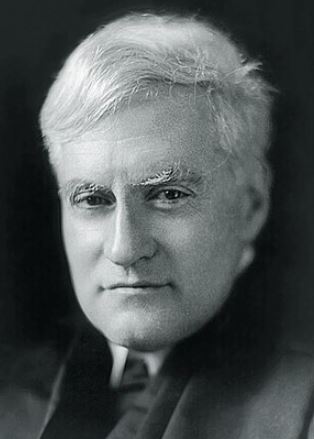 Benjamin Nathan Cardozo (1870-1938) was born in New York City to a traditional Sephardic Jewish family that immigrated to America before the Revolution. The family grew wealthy and influential over the decades, and Cardozo’s father was a New York Supreme Court judge while his uncle (who he was named after) had been vice president of the New York Stock Exchange. His cousin was (former Jew of the Week) Emma Lazarus. Cardozo went into law like his father, studying at Columbia and passing the bar in 1891. After more than two decades of practicing law, the widely beloved Cardozo got elected to the New York Supreme Court. He continued as judge in various positions and on different courts until being appointed to the US Supreme Court in 1932. The New York Times wrote of this that “seldom, if ever, in the history of the Court has an appointment been so universally commended.” It was one of the few cases in American history that a Democrat judge was appointed by a Republican president. (President Hoover originally did not want Cardozo since there was “already a Jew” on the court, Louis Brandeis.) Cardozo went on to be hugely influential in the development of American law. His collected lectures given at Yale University are still standard reading for judges today. He was also a cofounder of the American Law Institute, to “promote the clarification and simplification of the law and its better adaptation to social needs, to secure the better administration of justice, and to encourage and carry on scholarly and scientific legal work.” Totally absorbed in his work, Cardozo never married or had children. He is regarded as one of the greatest Supreme Court justices in American history. Yeshiva University’s Cardozo School of Law is named after him.
Words of the Week
… any talk of driving the Jews into the Mediterranean, as we have heard over the last few weeks or the last several years, is not only unrealistic talk, but it is suicidal talk for the whole world and I think also it is terribly immoral. We must see what Israel has done for the world. It is a marvelous demonstration of what people together in unity and with determination, rugged determination, can do in transforming almost a desert into an oasis.
– Martin Luther King, Jr.
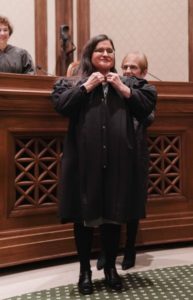
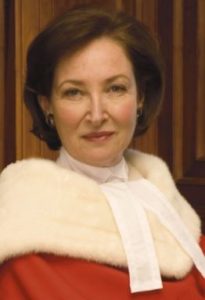 Rosalie Silberman Abella (b. 1946) was born to Jewish-Polish Holocaust survivors in a displaced persons camp in Germany. When she was a child, the family moved to Halifax, and then settled in Toronto. Abella followed in her father’s footsteps and became a lawyer, graduating from the University of Toronto. She was a civil and family lawyer for five years before being appointed to the Ontario Family Court, aged just 29. This made her the youngest judge in Canada’s history – and the first pregnant one! Sixteen years later, she moved up to the Ontario Court of Appeal. Abella also sat on Ontario’s Human Rights Commission, and became a renowned expert on human rights law. Abella coined the term “employment equity” while overseeing the Royal Commission on Equality in Employment in 1983. She pioneered a number of strategies to improve employment for women, minorities, and aboriginals, which have been implemented in countries around the world. In 2004, she was appointed to Canada’s Supreme Court, making her the first Jewish woman to sit on the nation’s highest judiciary. Recently, Abella was named the Global Jurist of the Year for her work with human rights and international criminal law. Among her many other awards, she has received 37 honourary degrees, including one from Yale University – the first Canadian woman to do so. One politician said of her: “I’ve never met any judge in my life, and I know a lot of them – I used to be a lawyer – who understands people better than Rosie, and the importance of people in the judicial process. I think the human quality she brings to the bench is unsurpassed in my experience.”