Tag Archives: New York

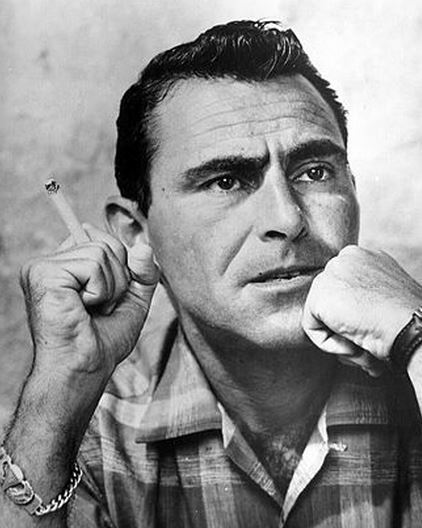
Jew of the Week: Rod Serling

The Twilight Zone

Rod Serling

Rod Serling

Rodman Edward Serling (1924-1975) was born in Syracuse, New York. From a very young age he was drawn to performing, spending hours each day acting in his basement. Initially a class clown, and thought to be a “lost cause” by his teachers, Serling was soon a key member of his high school debate team, a public speaker, journalist, athlete, and social activist. The day after graduating high school, he enlisted in the army and fought in World War II as a paratrooper, earning a Purple Heart and a Bronze Star, among other medals. After the war, he studied physical education, then switched to theatre, broadcasting, and literature. It was in his college days that he began writing, directing, and acting in radio programs. He struggled to break through in the radio industry for several years after, meanwhile earning money on the side by participating in dangerous flight experiments for the Air Force (and nearly getting himself killed on multiple occasions). He then tried his luck at television, and after many years of writing scripts, Serling finally got a break. His 72nd script, Patterns, earned many accolades and was described by some at the time as the best program in the short history of television. After this success, he had little worry finding jobs. However, corporate sponsors and politicians always meddled with his scripts. Fed up with this, Serling created his own show: The Twilight Zone. The series became an instant hit, and in 2013 was ranked as the third best TV show of all time. Serling went on to write and produce a number of other television, film, and radio programs. He also wrote many short stories and poems, and published 11 books. On top of this, Serling taught film and media at colleges across the US. Throughout his life, his primary goal was to spread awareness of human equality, world peace, and social justice. This was the underlying theme of all of his work, and Serling himself often stated that “the ultimate obscenity is not caring.” Sadly, Serling died at the young age of 50 from a string of heart attacks. He is credited with helping to establish television as a serious medium, and his episode of Patterns was the first TV rerun in history. He was ranked first among the “25 Greatest Sci-Fi Legends” by TV Guide. Serling won 8 Emmys, 3 Hugo Awards, and a Golden Globe, among others, and has been inducted into both the Television Hall of Fame and the Science Fiction Hall of Fame.

Words of the Week

As long as they talk about you, you’re not really dead, as long as they speak your name, you continue. A legend doesn’t die, just because the man dies.
– From an episode of The Twilight Zone (written by George Clayton Johnson)


Jews of the Week: Sarah Hughes and Dylan Moscovitch

World-Class Figure Skaters

Sarah Hughes, with former president George W. Bush

Sarah Hughes, with former president George W. Bush

Sarah Hughes (b. 1985) was born in New York to an Irish-Canadian father and a Jewish mother. She began ice skating when she was just three years old. By 1988 she won the US Junior Championships in figure skating, and the following year took silver at the World Junior Championships. After strong performances at a number of other events, Hughes qualified for the 2002 Winter Olympics, and graced the cover of TIME Magazine. Despite being just 16 years old, and the underdog, she won the gold medal at the Olympics in Salt Lake City. Away from the rink, Hughes is an active breast cancer awareness spokesperson, inspired by her mother, who is a breast cancer survivor. For over a decade, Hughes has also worked with Figure Skating in Harlem, a program providing free skating lessons to disadvantaged girls, as well as Skate for Hope, and the Women’s Sports Foundation. She graduated from Yale University in 2009.

Dylan David Moscovitch

Dylan David Moscovitch (b. 1984) is a Canadian figure skater with Romanian, Russian, and South African Jewish roots. He began skating at 13 months, and went on to compete in pairs figure skating competitions. He won gold and a couple of silvers at Canadian Championships, as well as a silver at the Four Continents Championships in Japan. Moscovitch competed at the Sochi Olympics earlier this year and won silver there, too. When not on the ice, he teaches the Israeli martial art Krav Maga.

Words of the Week

Where is God found? Wherever you let Him in.
– Menachem Mendel of Kotzk, the Kotzker Rebbe

Jew of the Week: Emile Berliner

Inventor of the Gramophone and Helicopter

Emile Berliner, inventor of the Gramophone and the helicopter

Emile Berliner, inventor of the Gramophone and the helicopter

Emile Berliner (1851-1929) was born in Hanover, Germany. Though he studied to be a merchant like the rest of his family members, he was always more interested in invention. With the outbreak of the Franco-Prussian War in 1870, Berliner fled to the US and settled in New York. During the day, he struggled to make ends meet by delivering newspapers and doing other petty jobs, while at night he studied physics. He became interested in the new technology of telephone and began working on sound transmission. Berliner first invented a new phone transmitter that was later adapted to make the first microphone. Bell Telephone Company bought out his patent and hired Berliner. He worked for Bell until 1883, when he established his own company. Building on previous phonograph technology, Berliner revolutionized the world in 1887 by inventing the gramophone and the flat disc record. At first, it was sold as just a toy, and only in Europe. In 1895, Berliner managed to get a $25,000 investment for his invention, and started the US Berliner Gramophone Company. Unfortunately, others stole his patents and sold unauthorized records, and Berliner was eventually unable to sell his own invention. He moved to Canada, started a new company, and soon focused on other technologies. One of these was an automatic loom for mass-producing clothes. Another, more famous, was the first helicopter. For over twenty years, Berliner focused on developing vertical flight machines, with the help of a number of other inventors and scientists. He designed the vertical rotor that made modern helicopters possible. In 1922, Berliner demonstrated the first helicopter to the US Army. Meanwhile, Berliner wrote and published five books, and was a noted advocate for public health and better sanitation. He won a number of prestigious awards for his work, which forever transformed the music, clothing, and flight industries.

Words of the Week

The souls of all the living… On Rosh Hashanah will be inscribed and on Yom Kippur will be sealed: how many will pass from the earth and how many will be created; who will live and who will die… Who will rest and who will wander, who will live in harmony and who will be harried, who will enjoy tranquility and who will suffer, who will be impoverished and who will be enriched, who will be degraded and who will be exalted. But repentance, prayer, and charity avert these severe decrees!
– Verses from Unetanneh Tokef, sung during Rosh Hashanah prayers