First Jewish Tennis World Champion and No. 1
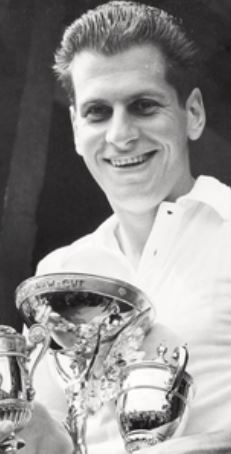 Richard Savitt (1927-2023) was born in New Jersey. He grew up playing basketball, but bad knees forced him to drop the sport. Meanwhile, Savitt had started playing tennis at the age of 14 just for fun. He ended up making it all the way to the state championship—having never taken a single tennis lesson in his life! By the time he was in university, he was ranked 8th best among American juniors. After serving in the US Navy during World War II, he captained Cornell’s tennis team and won several titles. He went on to win both the 1951 Wimbledon championship and the 1951 Australian Open, becoming the first Jewish tennis player to win either title. It put him on the cover of TIME Magazine, and he was the first Jewish athlete with that distinction, too. Unfortunately, Savitt faced antisemitism at a time when tennis was considered an elite “country club sport” and many country clubs still banned Jews from membership. Savitt was snubbed from the 1951 US Davis Cup team, and from being ranked the world’s number one player. Many believe this was due to antisemitism, but Savitt himself liked to think that wasn’t the reason. (The New York Times declared him the world’s No. 1 anyway, despite his official ranking remaining at No. 2.) Savitt has been credited with making tennis a more popular sport among Jews, and in Israel where he helped run the country’s Israel Tennis Centers. He also played a big role in supporting and expanding Israel’s Maccabiah Games, and himself won multiple Maccabiah gold medals. Savitt was inducted into the International Tennis Hall of Fame in 1976, and the International Jewish Sports Hall of Fame in 1979. After retiring from tennis, he worked in the oil and finance industries. Sadly, Savitt passed away earlier this year.
Top 10 Greatest Jewish Athletes
Words of the Week
…There is not any city of the Greeks, nor any of the barbarians, nor any nation whatsoever, whither our practice of resting on the seventh day hath not come, and by which our fasts and lighting up lamps, and many of our prohibitions as to our food, are not observed; they also endeavour to imitate our mutual concord with one another, and the charitable distribution of our goods… and, what is here matter of the greatest admiration, our law hath no bait of pleasure to allure men to it, but it prevails by its own force; and as God Himself pervades all the world, so hath our law passed through all the world also.
– Josephus (c. 37-100 CE), Against Apion 2:40
 Amy Renee Krouse Rosenthal (1965-2017) was born in Chicago and studied at Tufts University. A naturally creative and spiritual person, she described herself simply as “a person who likes to make things”. After working in advertising for nine years, Rosenthal decided to pursue her passion and becoming a writer. She published her first book in 1998 and went on to write 30 more, most of them children’s books. Many were New York Times Bestsellers, and Rosenthal is the only author to have three children’s books on the list of Best Children’s Books for Family Literacy in the same year. Her book Duck! Rabbit! was read publicly at the White House in 2010, and her adult book Encyclopedia of an Ordinary Life was named one of the top ten memoirs of the decade. She also published 10 journals and created many short films, several of which went viral. Rosenthal was often seen at TED talks, designing three conferences and speaking at another three. She wrote for a number of newspapers and magazines as well, including Parenting, The Oprah Magazine, and The New York Times. It was in the latter publication that she wrote an essay earlier this month revealing that she had terminal cancer. The