Tag Archives: Israel

Jews of the Week: Bielski Partisans

The Jewish Avengers

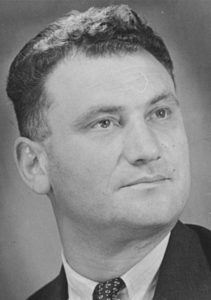
Tuvia Bielski

Tuvia Bielski (1906-1987) was born in a small village near what is today Navahrudak, Belarus (then part of the Russian Empire). When the German Army occupied the area during World War I, he was called to work for them as an interpreter, since he knew Polish, Russian and Yiddish. After the war, his hometown reverted to Polish rule, and Bielski was drafted to the Polish Army. He finished his service with the rank of corporal, then returned home to work in the family grain mill. When Nazi Germany invaded in 1939, Bielski was called up to fight. His cousin Yehuda Bielski (1909-1994), who had served as an officer in the Polish Army, was called up, too, and was shot in the leg. When SS troops stormed his hospital, he managed to escape. The Poles surrendered shortly after and the Bielski cousins returned to their village. The Nazis arrived there in the summer of 1941 and forced all the Jews into the Navahrudak ghetto. Tuvia, his sister, and three brothers fled to the Naliboki Forest; their parents, and two other brothers, were killed in the ghetto. The wife and baby daughter of his brother, Alexander “Zus” Bielski (1912-1995), were killed as well. In the forest, the Bielski brothers and 13 friends formed a paramilitary group under the command of Tuvia and brother Asael Bielski (1908-1945), launching a guerrilla war campaign against the Nazis. Through a Christian friend, they got a letter out to cousin Yehuda to join them and share his military expertise, which he did after escaping the ghetto.

The Bielski Partisans quickly grew to a force of about 150 fighters, and freed over 1200 Jews (including Jared Kushner’s grandmother) from the ghetto and surrounding villages. They worked to sabotage Nazi plans, destroying 4 bridges, 23 train cars, 32 telegraph lines, and killing nearly 400 soldiers. Their primarily goal, however, was to save lives. (Tuvia’s motto: “I would rather save one old Jewish woman than kill ten German soldiers.”) The Bielski Partisans built their entire life in the forest, constructing a school and hospital, bathhouse, bakery, tannery, synagogue, and even a courthouse and jail. The place became known as “Forest Jerusalem”. It had 125 full-time workers who also supplied the Soviet Army and other partisan forces in the area. The Nazis soon placed a 100,000 Reichsmark reward for the capture of Tuvia, and in August of 1943 launched a huge operation in the Naliboki Forest. While they were unable to suppress the Bielskis, they damaged most of their infrastructure, and punished many surrounding villages. The Bielskis ultimately joined forces with the Soviets and helped drive the Nazis out. (Throughout this time, they kept the identity of Yehuda secret, since the Soviets considered Polish officers to be enemies, and would have executed him immediately.) After the region was liberated in the summer of 1944, the Soviets turned on the Bielskis and the brothers fled. Unable to escape, Asael was conscripted to the Soviet Army and died in the Battle of Konigsberg in 1945. Tuvia and Zus, along with younger brother Aron Bielski (b. 1927)—who was only 12 when the war started—made their way to Israel and fought in the new state’s Independence War. Yehuda Bielski was there, too, and was injured in battle yet again. He rose to the rank of lieutenant in the IDF. The Bielskis eventually settled in New York, where they built a successful transportation company with a fleet of taxis and trucks. The story of the Bielski brothers was featured in two books, and a Hollywood film, Defiance, starring Daniel Craig as Tuvia.

Words of the Week

It’s the small acts that you do on a daily basis that turn two people from a “you and I” into an “us”.
Rabbi Menachem Mendel Schneerson (1902-1994), the Lubavitcher Rebbe
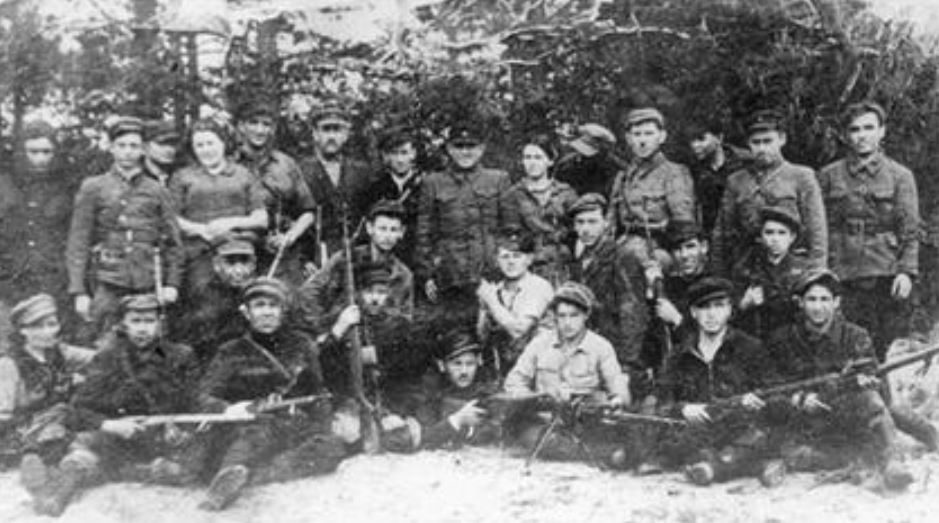
The Bielski Partisans in the Naliboki Forest

Jew of the Week: Gershom Sizomu

First Jew in Uganda’s Parliament

Gershom Sizomu (b. 1972) was born in Uganda in a village of the Abayudaya, a group of Ugandans who had converted to Judaism a century ago under the leadership of (former Jew of the WeekSemei Kakungulu. Unfortunately, in recent decades many rabbis, including the Israeli Rabbinate, did not accept their conversion, especially because many Abayudaya were forcibly converted to Christianity, while others went into hiding during the violent regime of Idi Amin. Sizomu invited a group of American Conservative rabbis to do a formal conversion in 2003. Some 300 Abayudaya converted, though many more refused to participate in the ceremony since they considered themselves fully Jewish already. Sizomu affirmed that it was only a formality, stating “We’re already Jewish.” He said in the ceremony “I was born Jewish, and I’d like to stay Jewish.” Following this, Sizomu headed to the US to study at the Ziegler School of Rabbinic Studies at the American Jewish University in Los Angeles. After five years, he was ordained a Conservative Rabbi. Upon his return to Africa, Sizomu converted another 250 people from Uganda, Kenya, Nigeria, and South Africa. In 2016, Sizomu ran in the Ugandan parliamentary elections and won a seat, beating seven other candidates. This makes him the first rabbi (and the first Jew!) in Uganda’s parliament. He has been working diligently to reduce government waste, alleviate poverty, and improve the country’s water and electrical networks. Sizomu is still the spiritual leader of 2000 Abayudaya Jews, and oversees seven synagogues, two Jewish schools, and a mikveh. Last year, he organized the first Birthright trip for a group of 40 Abayudaya youths. While the Jewish Agency for Israel has officially recognized the Abayudaya, the Israeli Interior Ministry still hasn’t. Sizomu is currently working towards changing that, and is very hopeful. He has said: “We are not Jewish for purposes of immigration. We are Jewish because that is who we are, and we will never change that…” and that “If the Arab world declared war on Israel, we would fight and die to protect it.”

Words of the Week

He who has a why to live can bear almost any how.
– Friedrich Nietzsche

Jews of the Week: Amy Alcott and Laetitia Beck

Two Great Women in Golf

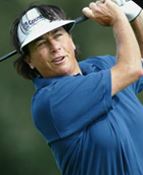
Amy Alcott (Credit: World Golf Hall of Fame)

Amy Alcott (b. 1956) was born in Kansas City, Missouri. She played golf for the first time when she was nine years old, and the golf club was so impressed they give her special access to their facilities. At age 18, Alcott decided to skip college and become a professional golfer. She joined the LPGA and won her first tournament shortly after, as well as the Rookie of the Year award. Alcott went on to win a whopping 29 LPGA tour championships, 5 of them majors. In 1983 she became only the sixth golfer ever to make a million dollars in winnings. Alcott donated much of those earnings, and was awarded the Founders Cup three years later for her philanthropic work. In 1986, she became the third golfer ever to make two million dollars. She was inducted into the World Golf Hall of Fame in 1999, as well as to the National Jewish Sports Hall of Fame. Since retiring from professional play, Alcott has turned to coaching girls golf, painting, and designing golf courses. Perhaps her most famous work is designing the golf course at the 2016 Rio Olympic Games.

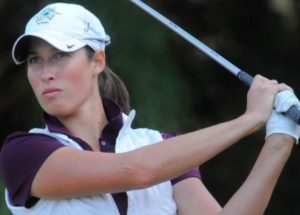
Laetitia Beck

Playing on that course and representing Israel in golf for the first time was Laetitia Beck (b. 1992). Beck was born in Belgium to a religious Jewish family which made aliyah to Israel when she was six years old. The family settled in Caesarea, near Israel’s only full golf course. Like Alcott, Beck first played golf at age 9. At just 12, she was the ladies champion at the Israel Open, and won again the following year. She then moved to the US for better opportunities and tougher competition. At 18, she returned to Israel and enlisted in the IDF. However, after completing all her exams she was given an exemption from service under the category of being a “sports prodigy”. She joined the LPGA Tour and became the first Israeli ever to do so. Beck always sports an Israeli flag somewhere on her uniform, and has said that “My goal is to represent Israel and the Jewish people.” She has done this extremely well, as she always keeps a kosher diet wherever in the world she plays, and never performs on Jewish holidays. When she declined an invitation to a golf tournament in October 2011 because it conflicted with Yom Kippur, she was compared to Sandy Koufax, who famously missed a game of the 1965 World Series for the same reason. Meanwhile, Beck earned an undergraduate degree from Duke University in 2014, where she had played for the school’s golf team, the Blue Devils. So far, Beck has won two golds at the Maccabiah Games, and five Israeli Opens (with the most recent ones played in the men’s division), as well as a Rookie of the Year award, and two appearances on the All-American golf team. She is teeing off tomorrow morning at the Thornberry Creek LPGA Classic.

Words of the Week

The Sabbaths are our great cathedrals; and our Holy of Holies is a shrine that neither the Romans nor the Germans were able to burn…
– Rabbi Abraham Joshua Heschel