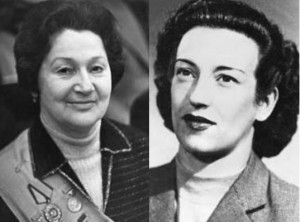
Gorokhovskaya and Keleti
Agnes Keleti (b. 1921) was born in Budapest and was Hungary’s national gymnastics champion by age 16. Shortly after, World War II began, forcing Keleti to go into hiding. Much of her family, including her father, were killed in the Holocaust. Keleti survived by posing as a Christian villager. After the war, she began training once more, but had to overcome injuries that prevented her from competing. Determined to go on, she qualified for the 1952 Helsinki Olympics, and won 4 medals, including a gold. Keleti returned to the Olympics in 1956, winning 6 more medals, 3 of which were gold. Being 35 years old at the time made her the oldest-ever gold medal winner in her sport. Her ten total medals makes her among the most decorated female athletes of all time. She also won at the 1954 World Championship. After the Soviet Union’s invasion of Hungary in 1956, Keleti immigrated to Israel, where she still lives today.
A very similar story is that of Maria Gorokhovskaya. Like Keleti, she was born in 1921 (in Ukraine) and took up gymnastics at a young age. After surviving the war, she also competed at the 1952 Helsinki Games, winning 2 golds and 5 silvers. Her 7 medals in one Olympiad is still a world record. Like Keleti, Gorokhovskaya won at the 1954 World Championships, too. With the collapse of the Soviet Union, she made aliyah to Israel in 1990. Both Keleti and Gorokhovskaya have been inducted in the Jewish Sports Hall of Fame. In addition, Keleti has been inducted to the Hungarian and Gymnastics Halls of Fame.
Words of the Week
Everything that is for the sake of God should be of the best and most beautiful… When one feeds the hungry, one should feed them of the best and sweetest of one’s table. When one clothes the naked, one should clothe them with the finest of one’s clothes.
– Maimonides
 Feigele Peltel (1921-2012) was born in Warsaw, Poland. At 21 she joined the Jewish Combat Organization. Using her “Aryan” looks and fluency in Polish, she was able to pose as a Pole and come in and out of the Warsaw Ghetto. Through this, she smuggled weapons and supplies in, while saving countless children (and adults) by bringing them out of the ghetto. Her code name was ‘Vladka’, which she later adopted as her legal name. She also worked as a recruiting agent to bring more people into the resistance. One of these was Benjamin Meed, whom she would later marry in the U.S. Together they were among the key organizers of the infamous Warsaw Ghetto Uprising. Vladka wrote a popular book about her experiences, and along with her husband, continued to work in Holocaust education for the rest of her life.
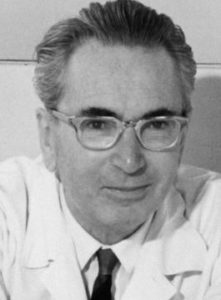 Meanwhile, Viktor Emil Frankl (1905-1997) was a distinguished psychiatrist and neurologist in Austria. He showed a talent for psychology at an early age, and provided psychoanalysis for high school students free of charge while in med school. He later worked in the dreaded “Suicide Pavilion” where he treated over 30,000 women at risk for suicide. After the Nazi takeover, Frankl was first demoted, then imprisoned, and spent three years in concentration camps. He used these experiences to develop a new philosophy of psychology, described in his world-famous book Man’s Search for Meaning (originally titled Saying Yes to Life in Spite of Everything). Frankl founded logotherapy, based on the belief that the central motivating force in humans is to find meaning in life, and most problems stem from this deficiency. Frankl revolutionized the field of psychology, wrote several highly-acclaimed books, and won multiple prestigious awards. Interestingly, he proposed that just as there is a Statue of Liberty on the East Coast, there should be a Statue of Responsibility on the West Coast. Plans are now in the works to build