Category Archives: Arts & Entertainment

Jews in the World of Art & Entertainment

Jew of the Week: Idina Menzel

Let it Go!

Idina Menzel in 'If/Then' (Photo Credit: Joan Marcus, www.joanmarcusphotography.com/)

Idina Menzel in ‘If/Then’ (Photo Credit: Joan Marcus)

Idina Kim Menzel (b. 1971) was born in New York to a Jewish family with grandparents from Russia and Eastern Europe. At 15, she began singing at weddings and bar mitzvahs, which later helped her get through Tisch School of Arts at New York University. Shortly after, she auditioned for the hit Broadway musical Rent, landing the role of Maureen Johnson, for which she was nominated for a Tony Award for Best Featured Actress in a Musical. She also starred in other hit shows like Hair and Aida, while releasing her first solo music album. Her greatest Broadway success began in 2003 when she started playing Elphaba in the musical Wicked, winning a Tony Award for Best Leading Actress. When the show opened in London, she became the city’s highest-paid female performer, earning $30,000 per week. Since 2008, she’s starred in Chess, Nero, and her latest, If/Then. The latter has now moved to Broadway, and Menzel has been nominated for another Tony for Best Leading Actress. Aside from her tremendous stage success, Menzel has also played roles in television and film, including a role on Glee. Most popularly, she lent the voice of Elsa in Disney’s Frozen, helping to make it the highest-grossing animated film of all time, and winning its theme song “Let it Go” an Academy Award. It also made Menzel the only Tony Award winner to ever hit the Billboard Top 10. Her most recent album, Holiday Wishes, hit the Billboard Top 10, as well. Menzel is heavily involved in charity work, and her ‘A BroaderWay Foundation’ helps disadvantaged youth make it in the arts through summer camps, scholarships, and workshops.

Words of the Week

…contrary to those who misunderstand or misrepresent this in terms of privilege, which smacks of chauvinism, this ‘chosenness’ [of the Jewish people] is primarily a matter of duty, and obligation to be a model people for the whole world to emulate; a people where form takes precedence over matter, the spiritual over the material, and the soul over the body, a people which was destined to be a “light unto the nations” (Isaiah 42:6).
– Menachem Mendel Schneerson, the Lubavitcher Rebbe
Jew of the Week: Rod Serling

The Twilight Zone

Rod Serling

Rod Serling

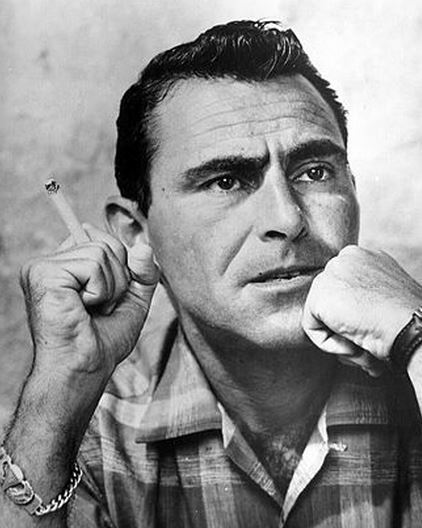
Rodman Edward Serling (1924-1975) was born in Syracuse, New York. From a very young age he was drawn to performing, spending hours each day acting in his basement. Initially a class clown, and thought to be a “lost cause” by his teachers, Serling was soon a key member of his high school debate team, a public speaker, journalist, athlete, and social activist. The day after graduating high school, he enlisted in the army and fought in World War II as a paratrooper, earning a Purple Heart and a Bronze Star, among other medals. After the war, he studied physical education, then switched to theatre, broadcasting, and literature. It was in his college days that he began writing, directing, and acting in radio programs. He struggled to break through in the radio industry for several years after, meanwhile earning money on the side by participating in dangerous flight experiments for the Air Force (and nearly getting himself killed on multiple occasions). He then tried his luck at television, and after many years of writing scripts, Serling finally got a break. His 72nd script, Patterns, earned many accolades and was described by some at the time as the best program in the short history of television. After this success, he had little worry finding jobs. However, corporate sponsors and politicians always meddled with his scripts. Fed up with this, Serling created his own show: The Twilight Zone. The series became an instant hit, and in 2013 was ranked as the third best TV show of all time. Serling went on to write and produce a number of other television, film, and radio programs. He also wrote many short stories and poems, and published 11 books. On top of this, Serling taught film and media at colleges across the US. Throughout his life, his primary goal was to spread awareness of human equality, world peace, and social justice. This was the underlying theme of all of his work, and Serling himself often stated that “the ultimate obscenity is not caring.” Sadly, Serling died at the young age of 50 from a string of heart attacks. He is credited with helping to establish television as a serious medium, and his episode of Patterns was the first TV rerun in history. He was ranked first among the “25 Greatest Sci-Fi Legends” by TV Guide. Serling won 8 Emmys, 3 Hugo Awards, and a Golden Globe, among others, and has been inducted into both the Television Hall of Fame and the Science Fiction Hall of Fame.

Words of the Week

As long as they talk about you, you’re not really dead, as long as they speak your name, you continue. A legend doesn’t die, just because the man dies.
– From an episode of The Twilight Zone (written by George Clayton Johnson)

Jew of the Week: Menachem Golan

Menachem Golan

Menachem Golan

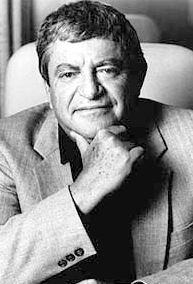
Menachem Globus (1929-2014) was born in Tiberias, Israel to Polish-Jewish parents. He served as an air force pilot and bombardier during Israel’s War of Independence (when he changed his last name to Golan). After this, he studied theatre and drama in England, followed by film-making in New York University. Together with his cousin Yoram Globus, Golan began making Israeli movies in the 1960s. They would go on to produce some of Israel’s most famous classics, such as Operation Thunderbolt about the IDF Entebbe raid that saved Israeli hostages in Uganda, and the comedy series Eskimo Limon, which left a permanent mark on Israeli culture. In 1979, Golan purchased the Cannon Group and expanded into Hollywood. Throughout the 1980s he produced some of the biggest action hits of the time, including Sylvester Stallone’s Over the Top, Chuck Norris’ The Delta Force, and Jean-Claude Van Damme’s Bloodsport and Kickboxer. He was also one of the first to see the allure of adapting toys and comic books to film, producing Masters of the UniverseSuperman IV, and trying to bring Spider-Man to the big screen (it did only after Sony bought out the film rights). In all, Golan produced over 200 films, and directed 44 of them himself, earning three Academy Award nominations, and the Israel Prize. Sadly, Golan passed away last Friday. Paying tribute to the filmmaker, Chuck Norris said that it was Golan who turned him into a superstar, and Van Damme tweeted: “I love you, and will always do.”

Words of the Week

…splitting Judaism into ‘orthodox, conservative, and reform’ is a purely artificial division, for all Jews share one and the same Torah given by the One and same God. While there are more observant Jews and less observant ones, to tack on a label does not change the reality that we are all one.
– Menachem Mendel Schneerson, the Lubavitcher Rebbe